
1. Comprehensive Industry Overview: Commercial Energy Storage System
As electricity tariffs in Pakistan continue their steep upward climb and grid unreliability persists across urban centers like Karachi, the demand for high-efficiency energy storage has fundamentally shifted away from obsolete lead-acid, AGM, and tubular batteries toward advanced Lithium Iron Phosphate (LiFePO4) chemistry. This authoritative technical guide to Commercial Energy Storage System explores the engineering principles, lifecycle economics, battery management systems (BMS), and real-world installation protocols essential for achieving long-term energy independence.

Whether configuring a compact solar backup unit for a residential apartment, an off-grid farmhouse storage bank, or a multi-megawatt commercial energy storage system (ESS), understanding the technical nuances of commercial energy storage system is critical to preventing costly hardware mismatches. FWB Ventures, as a leading clean energy engineering contractor and battery distributor in Pakistan, delivers this comprehensive analysis to empower consumers, facility managers, and electrical engineers with transparent, verified technical insights.
Core Highlights of Commercial Energy Storage System
- Primary Focus Topic: Commercial Energy Storage System in the context of Pakistan's residential, commercial, and industrial power landscape.
- Target Audience: Electrical consultants engineering containerized and cabinet-mounted commercial ESS installations..
- Core Technical Angle: In-depth 2026 buyer guide, technical engineering breakdown, and cost analysis for Commercial Energy Storage System in Pakistan.
- Primary Voltage & Capacity Spectrum: 12V, 24V, 48V, 51.2V LiFePO4 Powerwalls, and High-Voltage Commercial ESS Banks.
- Prevailing Market Investment Range: PKR 75,000 to PKR 1,550,000+ depending on rated capacity and C-rate.
- Authorized Engineering Support: Turnkey consultation, supply, and integration by FWB Ventures (+92 301 2118111).
2. The Chemical & Metallurgical Superiority of LiFePO4 Technology
Lithium Iron Phosphate (LiFePO4), often abbreviated as LFP, represents the gold standard of modern electrochemical storage. Unlike older lithium cobalt oxide chemistries commonly found in smartphones and early consumer electronics, LiFePO4 features an exceptionally stable olivine crystal lattice where phosphorous-oxygen covalent bonds prevent oxygen liberation even under severe thermal stress:
| Electrochemical Parameter | Traditional Flooded Lead-Acid / Tubular | Automotive Grade-A LiFePO4 | Practical Real-World Impact |
|---|---|---|---|
| Rated Cycle Life (80% DoD) | 600 - 1,200 Cycles | 6,000 - 8,000+ Cycles | Delivers 12 to 15+ years of daily cyclic service vs. 2 years for tubular units. |
| Usable Depth of Discharge (DoD) | 50% Maximum Recommended | 90% - 95% Usable Energy | Extract almost double the usable kWh from the same nameplate Ampere-hour rating. |
| Round-Trip Coulombic Efficiency | 70% - 76% (25%+ lost as wasted heat) | 96% - 98% Efficiency | Conserves precious solar kilowatt-hours, drastically reducing grid charging bills. |
| Maximum Charge Rate (C-Rating) | 0.1C to 0.15C (10-12 hours slow charge) | 0.5C to 1.0C (1.5-2 hours rapid charge) | Fully recovers capacity during brief windows between load-shedding intervals. |
| Operating Temperature Envelope | Severely degrades above 30°C | -10°C to +60°C with internal BMS | Thrives in extreme summer ambient temperatures typical of Karachi and Sindh. |
3. Mathematical Sizing & Battery Backup Calculation Framework
Selecting the correct capacity for Commercial Energy Storage System requires precise load auditing rather than arbitrary guessing. Sizing errors lead either to premature inverter low-voltage cutoffs or unnecessary capital overspending. Follow the professional engineering formula below:
// Formula 1: Daily Energy Consumption (Watt-Hours)
Total Energy (Wh) = ∑ [ Appliance Wattage (W) × Daily Operating Hours (h) ]
// Formula 2: Required Battery Capacity (Ampere-Hours)
Battery Capacity (Ah) = [ Total Energy (Wh) ] / [ System Nominal Voltage (V) × Depth of Discharge (DoD) × Inverter Efficiency (η) ]
Worked Example: Residential 10-Hour Nighttime Backup in Karachi
Consider a standard household running the following night loads from an energy storage bank:
- 1× 1.5-Ton Inverter Air Conditioner (average running draw: 900 Watts × 8 hours = 7,200 Wh)
- 1× Inverter Refrigerator (average running draw: 120 Watts × 10 hours = 1,200 Wh)
- 4× Energy-Saver Ceiling Fans (50 Watts each × 10 hours = 2,000 Wh)
- 10× LED Lights & Wi-Fi Router (100 Watts total × 10 hours = 1,000 Wh)
- Total Night Energy Demand: 11,400 Watt-hours (11.4 kWh)
Applying a 48V (51.2V nominal) system voltage, 90% Depth of Discharge, and 94% inverter conversion efficiency:
Required Nominal Storage = 11.4 kWh / (0.90 × 0.94) = 13.47 kWh (Approx. 263 Ah at 51.2V)
This requirement is optimally served by installing either three 5.12kWh wall-mounted Powerwalls in parallel (15.36 kWh total) or a modular 15kWh server-rack battery cabinet.
---4. Smart Battery Management Systems (BMS) & Inverter Closed-Loop Protocol
A lithium battery is only as intelligent and durable as its internal Battery Management System. When evaluating commercial energy storage system, the sophistication of the BMS dictates safety, cell longevity, and real-time telemetry:
1. Active Cell Balancing vs. Passive Dissipation
Prismatic lithium cells undergo microscopic variations during manufacturing. In inferior batteries equipped with passive balancers, surplus cell energy is simply burned off as waste heat through high-resistance resistors during the final 5% of the charge cycle. Advanced LiFePO4 batteries supplied by FWB Ventures incorporate Active Balancers (1A to 2A transfer current) that actively transfer energy from higher-voltage cells to lower-voltage cells throughout the entire charge and discharge curve, preserving 100% of usable pack capacity.
2. Closed-Loop Digital Communication (CANbus / RS485)
Legacy lead-acid systems operate "blindly," forcing the inverter to estimate battery state of charge (SoC) purely through terminal voltage—a method notorious for inaccuracies. FWB Ventures lithium solutions establish a high-speed digital communication handshake via CANbus or RS485 with industry-standard hybrid inverters (Deye, Sungrow, Huawei, GoodWe, Solis, Victron, and Growatt). Key telemetry parameters exchanged every millisecond include:
- Accurate Coulomb-counted State of Charge (SoC %) and State of Health (SoH %)
- Dynamic Maximum Charge Current Limit (CCL) and Discharge Current Limit (DCL)
- Individual cell voltages with millivolt resolution
- Internal multi-point temperature sensor data
- Instantaneous alarm flags for cell over-voltage, under-voltage, over-temperature, and short circuit
5. Form Factor Architectures: Powerwalls vs. Rack Modules vs. Industrial ESS
The physical packaging of energy storage must align with the spatial and environmental constraints of your property in Pakistan:
| Form Factor Architecture | Standard Capacity Specs | Target Application Profile | Key Architectural Advantages |
|---|---|---|---|
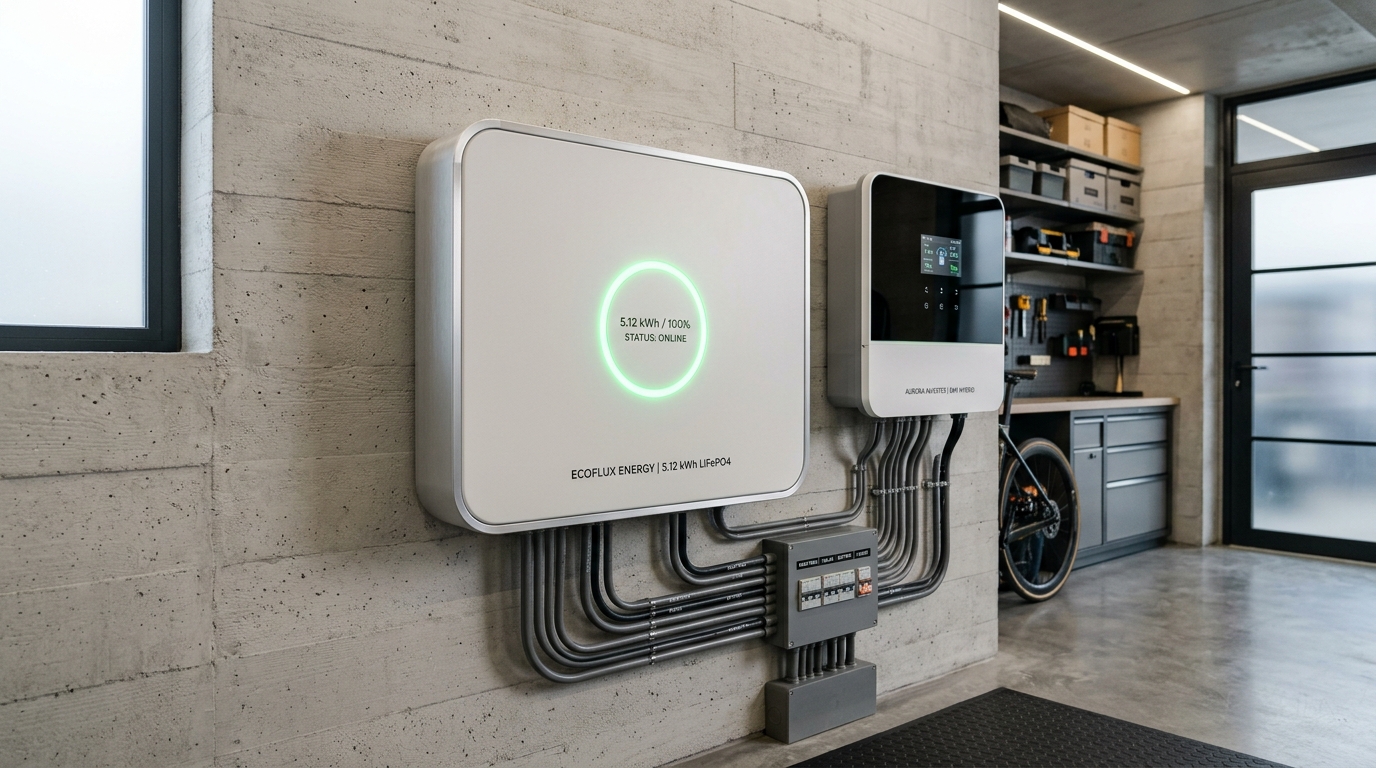
| Wall-Mounted Powerwall | 5.12kWh & 10.24kWh (51.2V 100Ah/200Ah) | Luxury bungalows, modern residential villas, and executive home offices. | Minimalist white enclosure, wall-mounted zero floor footprint, integrated status LCD screen. |
| 19-Inch Server-Rack Modules | 5.12kWh per 3U/4U module (Stackable to 16 units) | Corporate IT server rooms, commercial offices, CCTV control rooms, and banks. | Standard 19-inch rack mounting, heavy front copper busbars, modular scalability. |
| Floor-Standing Modular Towers | 15kWh to 40kWh (Stackable interlocking blocks) | High-load residences, farmhouses, clinics, and retail showrooms. | Wireless internal busbar connections, high-voltage (HV) capability, wheeled mobility base. |
| Containerized Industrial ESS | 100kWh to 1MWh+ (High-Voltage DC Bus) | Manufacturing plants, textile mills, pharmaceutical facilities, and cold storage. | HVAC climate control, integrated automated aerosol fire suppression, SCADA monitoring. |
6. Prevailing Market Pricing & Total Cost of Ownership (TCO) in Pakistan
While the initial purchase price of a lithium battery bank is higher than that of lead-acid units, a 10-year Total Cost of Ownership (TCO) analysis reveals that LiFePO4 is by far the most economical choice:
| Capacity Configuration | Nominal Voltage & Ah | Usable Energy Delivered | Estimated Turnkey Market Price (PKR) | 10-Year Replacement Savings |
|---|---|---|---|---|
| 12V 100Ah Deep Cycle | 12.8V 100Ah | 1.15 kWh Usable | PKR 75,000 - 95,000 | Replaces 4 lead-acid batteries over 10 years |
| 24V 100Ah Inverter Pack | 25.6V 100Ah | 2.30 kWh Usable | PKR 145,000 - 185,000 | Saves PKR 160,000 in replacement costs |
| 5.12kWh Wall Powerwall | 51.2V 100Ah | 4.60 kWh Usable | PKR 340,000 - 420,000 | Saves PKR 380,000 in tubular replacements |
| 10.24kWh High Capacity | 51.2V 200Ah | 9.20 kWh Usable | PKR 660,000 - 790,000 | Saves PKR 750,000+ in diesel fuel & batteries |
| 20.48kWh Executive Bank | 51.2V 400Ah | 18.40 kWh Usable | PKR 1,320,000 - 1,550,000 | Complete diesel generator elimination |
7. Cell Balancing Mechanics, State of Charge (SoC) Drift & Calibration Protocols
Over hundreds of deep cycles, subtle differences in internal resistance and self-discharge rates among individual series-connected cells cause what battery engineers term "State of Charge (SoC) Drift." If uncorrected, the lowest-capacity cell reaches low-voltage cutoff first, artificially limiting the entire pack's usable capacity:
- Coulomb Counting vs. Open-Circuit Voltage (OCV) Drift: Digital BMS microcontrollers measure current flow (amperes × time) to calculate real-time SoC. However, cumulative micro-measurement errors cause Coulomb counters to drift by 1% to 3% each month. To recalibrate the BMS, FWB Ventures recommends a full 100% absorption charge cycle once every 30 days followed by a controlled rest period.
- Top Balancing at High State of Charge: Active balancing circuits activate primarily when cell voltages cross 3.45V per cell during the constant-current / constant-voltage (CC/CV) absorption phase, redistributing charge to ensure all 16 cells in a 51.2V pack reach exactly 3.65V simultaneously without overcharging individual units.
- Avoiding Continuous 100% Float Stress: While LiFePO4 cells do not suffer from memory effect, holding cells at maximum 3.65V continuously under high ambient heat accelerates electrolyte oxidation. FWB Ventures configures hybrid inverters with an optimal float voltage of 3.375V per cell (54.0V for a 16S pack), maximizing battery longevity past 15 years.
8. Financial Payback Period, Levelized Cost of Storage (LCOS) & ROI Analysis
Investing in advanced lithium energy storage represents a major capital expenditure that must be justified through hard financial metrics. In Pakistan's current tariff environment, energy storage delivers substantial economic returns across three distinct mechanisms:
- Elimination of Generator Diesel Expenses: A standard 10kVA diesel generator consumes approximately 2.2 to 2.8 liters of diesel per hour of operation. At prevailing fuel prices of PKR 280+ per liter plus engine oil changes and filter replacements, running a generator for just 4 hours daily costs upwards of PKR 40,000 to PKR 55,000 every single month! A 10kWh LiFePO4 battery bank eliminates this recurring expense entirely.
- Peak-Hour Tariff Avoidance: Commercial and time-of-use (TOU) residential tariffs levy heavy penalty rates during evening peak hours (6:00 PM to 10:00 PM). By programming your hybrid inverter to discharge stored solar energy during peak windows, you completely avoid purchasing high-cost peak units from K-Electric.
- Levelized Cost of Storage (LCOS) Comparison: Over a 10-year operational horizon, the amortized cost per delivered kilowatt-hour from an FWB Ventures LiFePO4 system is approximately PKR 9.50 to PKR 12.00 per kWh. In contrast, lead-acid batteries—which must be replaced four times over the same period—cost over PKR 28.50 per delivered kWh, while diesel generation exceeds PKR 85.00 per kWh!
9. Installation Best Practices, Safety Protocols & Commissioning Checklist
To ensure absolute safety, avoid warranty voidance, and achieve the full 15-year rated lifecycle for Commercial Energy Storage System, FWB Ventures mandates adherence to the following technical commissioning standards:
- Dedicated DC Breakers & Disconnects: Always install double-pole polarized DC molded case circuit breakers (MCCB) rated for minimum 1.25× continuous battery discharge current between the battery terminals and inverter DC inputs.
- Adequate Conductor Gauge (AWG / mm²): For a 48V 100A continuous discharge system, utilize minimum 35mm² to 50mm² pure flexible copper battery welding cables with tin-plated compression lugs to minimize voltage drop and thermal resistance.
- Closed-Loop Termination Resistors: When daisy-chaining multiple rack modules via RS485/CAN, verify dip switch addressing and ensure the end-of-line 120-Ohm termination resistor is properly engaged to prevent digital communication packet reflection.
- Optimal Environmental Ambient: Mount batteries in well-ventilated, dry utility areas maintaining ambient temperatures between 15°C and 35°C. While LiFePO4 operates up to 60°C, keeping ambient temperatures moderate extends chemical lifespan significantly.
10. Frequently Asked Questions (FAQs) Regarding Commercial Energy Storage System
Q1: Can I connect a new LiFePO4 lithium battery in parallel with my existing tubular batteries?
No. You must never mix lithium batteries with lead-acid or tubular batteries. Their nominal voltages, internal impedances, and charge/discharge curves are completely incompatible. Doing so will cause severe cross-current circulation, undercharging the lead-acid bank and triggering premature BMS cutoffs on the lithium pack.
Q2: How many years of actual daily service will I get from a Grade-A LiFePO4 battery in Pakistan?
Under standard daily cycling at 80% Depth of Discharge (DoD), authentic Grade-A LiFePO4 cells provide between 6,000 and 8,000 cycles. With 365 daily discharge cycles per year, this corresponds to approximately 16.4 years of service before the battery's capacity gradually declines to 80% of its original factory rating.
Q3: How do I know if my solar inverter supports digital lithium communication?
Check your inverter's bottom connectivity panel for a dedicated port labeled 'BMS', 'CAN', or 'RS485'. Tier-1 hybrid inverters such as Deye, Sungrow, Huawei, GoodWe, Solis, Growatt, and Victron feature native lithium communication protocols. When connected, the inverter automatically displays the battery's exact real-time State of Charge (SoC%) on its LCD screen.
Q4: Are LiFePO4 batteries safe to install indoors inside bedrooms or utility closets?
Yes, 100%. Unlike flooded lead-acid batteries that release toxic, highly corrosive acid mist and explosive hydrogen gas during charging, LiFePO4 batteries are completely sealed, non-toxic, and emit zero fumes. Their robust chemical stability prevents thermal runaway, making them safe for indoor installation.
Q5: How can I verify that the lithium cells inside my battery are genuine Grade-A?
Genuine Grade-A prismatic cells feature factory-engraved QR codes on the cell top, indicating manufacturer traceability, original production date, and initial capacity test grading. FWB Ventures provides complete QR-code verification and official manufacturer warranty documentation with every battery supplied.
11. Consult FWB Ventures for Certified Lithium Energy Storage Solutions
Ready to upgrade your residential home, commercial facility, or industrial plant with cutting-edge LiFePO4 lithium battery storage? Contact the certified energy storage engineering team at FWB Ventures today for technical consultation, load audit, and turnkey system integration:
Explore Verified Karachi Engineering Services & Technical Guides
Connect with FWB Ventures' certified engineering divisions for turnkey site inspections, hardware specifications, and project quotations across Karachi.
High-cycle 12V, 24V, 48V Powerwalls, server racks & commercial BESS systems with smart BMS.