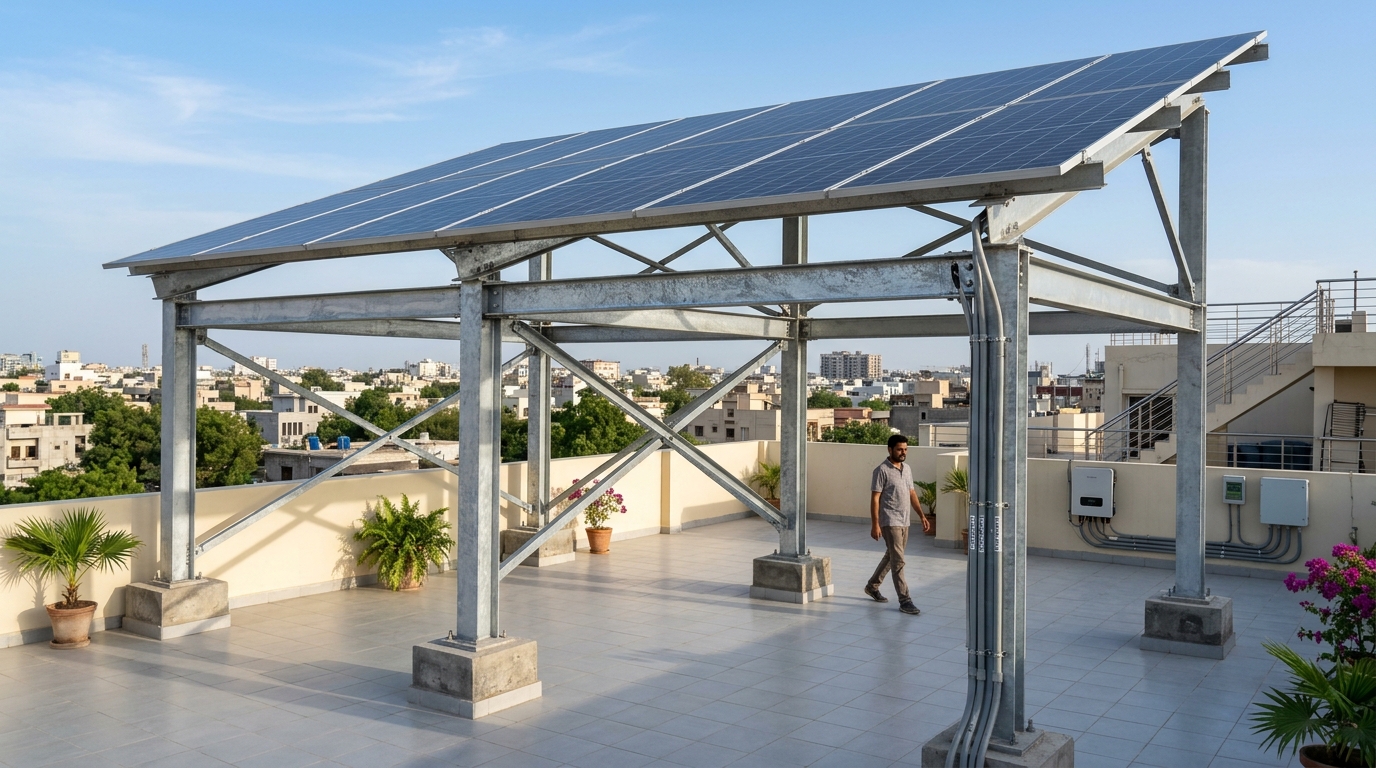
ASTM A123 Hot-Dip Galvanized & 6063-T5 Aluminum Solar Mounting Structures in Karachi
FWB Ventures provides certified Wind-Resistant Solar Structure Design in Karachi. Engineered with ASTM A123 hot-dip galvanized steel, 6063-T5 aluminum, FRP composites, and 25+ year coastal corrosion resistance in Karachi.
Engineered to endure severe Arabian Sea tropical cyclones and monsoon squalls, Wind-Resistant Solar Mounting Structures in Karachi by FWB Ventures provide structural peace of mind. Karachi’s open coastal geography regularly produces sudden localized wind gusts exceeding 130 km/h, generating immense aerodynamic uplift forces capable of ripping unbraced solar panels off rooftops.
Our wind-resistant structures are certified to withstand 140 km/h to 150 km/h wind velocities in compliance with the Sindh Building Control Authority (SBCA) and Pakistan Building Code. We utilize finite element analysis (FEA) computer modeling to optimize member cross-sections, incorporate diagonal knee-bracing trusses, and anchor base plates using high-strength chemical epoxy injection systems verified by on-site hydraulic pull-out testing.
Understanding why hot-dip galvanized steel outperforms generic painted iron in Karachi requires examining its electrochemical behavior:
The Four Intermetallic Zinc Layers: When clean structural steel is submerged into molten zinc at 450°C, a diffusion reaction occurs, forming four distinct metallurgical zones:
Gamma Layer (75% Zn, 25% Fe): Microscopic base boundary layer with Diamond Pyramid Hardness (DPH) of 330, harder than the underlying carbon steel.
Eta Layer (100% Zn): Pure outer zinc layer with DPH of 70, providing immediate sacrificial corrosion protection.
Bimetallic Galvanic Isolation: When aluminum solar panel module frames come into direct contact with carbon steel in the presence of salt-laden coastal moisture, a severe galvanic battery cell is formed, rapidly corroding the aluminum frame. FWB Ventures strictly incorporates dielectric EPDM isolation pads and nylon shoulder washers at every module clamp and fastener connection, completely isolating dissimilar metals and preventing galvanic corrosion.
FRP Composite Pultrusions (The 100% Non-Metallic Solution): For seaside properties within 1 km of the shoreline, FWB Ventures offers Fiber Reinforced Polymer (FRP) mounting profiles composed of continuous E-glass fibers embedded in an isophthalic polyester resin matrix. FRP profiles cannot corrode, require zero paint, are 100% non-conductive, and eliminate electrical earthing hazards entirely.
Engineering for Karachi's 45°C Summer Heat & High Humidity Cycles
Karachi experiences severe thermal cycling: rooftop concrete slabs and metal structures heat to over 65°C under peak summer sun, cooling down to 28°C at night in the presence of coastal dew. This continuous expansion and contraction loosens standard mechanical bolt connections:
Thermal Expansion Slotting: Long structural purlin runs (exceeding 12 meters) are engineered with oblong expansion slots and Teflon slip washers, accommodating thermal expansion without buckling panels or cracking photovoltaic cell wafers.
Vibration-Proof Serrated Flange Hardware: All structural nut-and-bolt connections utilize serrated flange Grade 8.8 hot-dip galvanized or AISI 304 stainless steel hardware that mechanically bites into the metal, preventing bolt loosening caused by continuous wind turbulence.
UV-Stabilized Cable Routing: Direct sunlight rapidly degrades standard electrical conduit and zip-ties. FWB Ventures utilizes UV-stabilized nylon cable ties and hot-dip galvanized perforated cable trays with snap-on covers, protecting solar DC cables from solar radiation and rodent damage.
Metallurgical & Structural Material Specifications
Technical benchmarks for solar mounting structure materials engineered by FWB Ventures:
How does hot-dip galvanized steel compare to painted iron frames in Karachi?
Painted iron relies on a thin, fragile coat of paint that chips, blisters, and traps moisture against bare metal, rusting completely within 2 to 3 years in Karachi's salt air. Hot-dip galvanization creates a metallurgical alloy bond of pure molten zinc 85 to 120 microns thick that self-heals scratches and provides over 25 years of maintenance-free service.
When should a homeowner in Karachi choose FRP fiberglass instead of galvanized steel?
FRP (Fiberglass Reinforced Polymer) is ideal for properties located directly on the coastline (such as DHA Phase 8, Clifton Beach, or Keamari) where salt spray is intense, or for rooftops where the building structure cannot support heavy steel dead loads. FRP cannot rust, is non-conductive, and weighs 40% less than steel.
What causes galvanic corrosion between solar panels and mounting frames?
Galvanic corrosion occurs when aluminum solar panel frames touch carbon steel in the presence of an electrolyte (like Karachi's salt-laden coastal humidity). The aluminum corrodes rapidly, weakening panel integrity. FWB Ventures prevents this by using dielectric EPDM rubber pads and stainless steel fasteners to electrically isolate the two metals.
Can a rusted existing solar structure in Karachi be repaired without replacing the panels?
Yes. FWB Ventures provides structural refurbishment: we temporarily secure panels, mechanically clean rust from structural members, apply cold-galvanizing zinc-rich primers (minimum 90% zinc dust), replace rusted bolts with AISI 304 stainless steel hardware, and install reinforced cross-braces.
Structural Wind Aerodynamics & SBCA Uplift Engineering in Karachi
Karachi’s geographical exposure along the Arabian Sea creates a severe aerodynamic environment for rooftop and ground-mounted solar installations. Unlike inland cities with low, steady wind patterns, Karachi experiences intense thermal afternoon sea breezes, seasonal monsoon squalls, and tropical coastal depressions. Unengineered solar structures utilizing lightweight sheet metal or unbraced frames experience structural fatigue, fastener pull-out, and catastrophic wind uplift failure.
In accordance with the Pakistan Building Code (PBC-2021) and Sindh Building Control Authority (SBCA) standards, FWB Ventures designs every solar mounting framework to safely withstand basic design wind speeds of 38 m/s to 42 m/s (136 km/h to 150 km/h). When wind flows over a solar array tilted between 20° and 26° South, it generates significant negative aerodynamic pressure (suction) on the leeward surface. Structural wind pressure is calculated using the standard aerodynamic formulation:
Aerodynamic Velocity Pressure Formula:
qz = 0.613 × Kz × Kzt × Kd × V2 × I
Where Kz is the terrain exposure velocity coefficient, Kzt is the topographic factor, Kd is the wind directionality factor (0.85), V is the basic wind speed (140 km/h), and I is the building importance factor.
To resist calculated uplift forces exceeding 1.2 to 1.8 kN/m², our structural engineers incorporate diagonal knee-bracing, triangulated truss profiles, and heavy-duty gusset reinforcement plates at all critical moment-resisting beam-to-column joints. This ensures the structural frame transfers aerodynamic uplift loads safely into the building’s primary reinforced concrete columns without flexing or stressing photovoltaic glass modules.
The single greatest operational hazard for solar mounting structures in Karachi is atmospheric chloride corrosion. Marine atmospheric zones—including DHA Phases 1 through 8, Clifton, Keamari, Korangi Creek, and Port Qasim—carry dense marine salt-fog mist and coastal humidity averaging above 75% year-round. Ordinary commercial steel frames, spray-painted iron angles, or thin pre-galvanized (Pre-GI) sheets with only 10 to 20 microns of zinc deteriorate into destructive red rust within 24 to 36 months.
FWB Ventures guarantees structural longevity by subjecting all fabricated steel components to the rigorous ASTM A123 / ISO 1461 Hot-Dip Galvanizing standard:
Full Immersion Zinc Bath: Fabricated steel members (after all cutting, punching, and welding are 100% complete) are submerged into a molten zinc bath held at 450°C. This guarantees that all internal surfaces, pre-punched bolt holes, and heat-affected weld zones receive complete metallurgical coverage.
Metallurgical Intermetallic Bonding: Molten zinc alloys directly with the base carbon steel, forming a series of iron-zinc alloy layers (Gamma, Delta, and Zeta layers) capped by a pure zinc Eta outer layer. The inner alloy layers actually exceed the structural hardness of the base steel itself, providing superior abrasion resistance against airborne Karachi desert sand particles.
85 to 120 Micron Coating Thickness: While cheap pre-galvanized sheets offer less than 20 microns of zinc, our hot-dip galvanized coating measures between 85 and 120 microns (minimum 610 g/m²). In Karachi’s marine corrosive category C4/C5 environment, where zinc degrades at approximately 2 to 3 microns annually, an 85+ micron hot-dip coating guarantees 25 to 30 years of zero-maintenance structural service.
Cathodic Sacrificial Protection: If the structural coating is scratched during solar panel mounting, the surrounding zinc sacrifices itself galvanically, sealing the exposed iron and preventing rust creep beneath the surface.
Precision Chemical Anchoring & RCC Roof Slab Waterproofing Integrity
A major concern for homeowners, corporate facility directors, and commercial developers in Karachi is protecting the integrity of the building’s reinforced concrete (RCC) roof slab. Drilling mechanically expanding wedge anchors frequently cracks aged concrete, damages internal reinforcing rebars, creates structural micro-fractures, and causes persistent ceiling water leaks during the monsoon rainy season.
FWB Ventures eliminates roof damage through engineered pure epoxy chemical injection anchoring:
Chemical Injection Anchoring System: We utilize Hilti HIT-RE 500 V3 or Fischer high-performance pure epoxy injection resins paired with Grade 8.8 hot-dip galvanized or AISI 316 stainless steel threaded anchor studs. Resin holes are diamond-core drilled to an engineered embedment depth of 100mm to 125mm (4 to 5 inches), completely avoiding expansion stresses and achieving pull-out tensile resistances exceeding 25 kN per anchor stud.
Concrete Rebar Detection: Before drilling, our technicians scan the concrete slab using electronic electromagnetic cover meters to pinpoint internal rebar positions, ensuring no structural reinforcing bars are severed or compromised.
Dual-Barrier Elastomeric Waterproofing: Each structural base plate is installed over a 5mm high-density EPDM rubber isolation gasket that dampens structural vibrations and seals the anchor interface. Following mechanical torquing to specified foot-pounds with calibrated torque wrenches, the entire perimeter of the base plate and bolt penetrations is encapsulated in heavy-duty polyurethane (PU) elastomeric sealant.
Reinforced Concrete Plinths (Pedestals): For elevated pergolas and high-clearance structures, we construct integrated RCC plinths (300mm × 300mm × 200mm curbs) directly over structural roof beams. This elevates steel base plates above standing roof ponding water, preserving structural integrity for decades.
Material Engineering Matrix: Hot-Dip Steel vs Aluminum 6063-T5 vs FRP Composites
Selecting the optimal mounting material depends on structural span requirements, building roof dead load limitations, and proximity to Karachi's coastal salt breeze. FWB Ventures manufactures and installs across all three leading structural material classifications:
Engineering Parameter
Hot-Dip Galvanized Steel (ASTM A123)
Structural Aluminum (6063-T5 Anodized)
Pultruded FRP Composite (E-Glass)
Primary Alloy / Composition
Structural Carbon Steel (Q235B / Q345B)
Al-Mg-Si Alloy (6063-T5)
Isophthalic Polyester + E-Glass Fiber
Corrosion Protection
85–120μm Hot-Dip Molten Zinc
15μm Clear Anodized Layer
100% Non-Metallic (Chemically Inert)
Yield Strength (Mechanical Rigidity)
235 to 345 MPa (Highest Rigidity)
160 to 210 MPa
250 to 300 MPa (Tensile)
Dead Weight Load on Roof Slab
28 to 35 kg per panel
10 to 14 kg per panel (Ultra-Light)
12 to 16 kg per panel (Lightweight)
Electrical Conductivity
Electrically Conductive (Requires Earthing)
Electrically Conductive (Requires Earthing)
Non-Conductive (Zero Grounding Hazard)
Coastal Lifespan in DHA / Clifton
25+ Years
20+ Years
30+ Years (Zero Rust Ever)
Best Application in Karachi
High Elevated Pergolas & Carports
Low-Rise L2/L3 Rooftop Racks
Coastal Bungalows & Chemical Plants
For high-clearance elevated pergolas requiring wide column spans (over 4 to 6 meters), Hot-Dip Galvanized Steel remains the undisputed industry standard due to its immense modulus of elasticity. For seaside residential roofs seeking to minimize dead weight or chemical plants exposed to aggressive acidic vapors, FRP composites offer an exceptional rust-free alternative.
Optimal Tilt Angle & Southern Azimuth Solar Geometry in Karachi
Karachi is geographically positioned at latitude 24.8607° N. Achieving maximum annual photovoltaic kilowatt-hour generation requires precise tilt angle orientation and azimuth alignment:
Optimal Year-Round Tilt Angle: For fixed-tilt residential and commercial solar structures in Karachi, the ideal tilt angle is engineered between 22° and 25° facing True South (180° Azimuth). This tilt geometry maximizes solar irradiance capture during both the high summer sun path and low winter angles, delivering an average annual solar irradiation of 5.3 to 5.6 peak sun hours daily.
Seasonal Adjustable Tilt vs Fixed Mounts: While seasonal adjustable frames (allowing manual adjustment between 15° in summer and 32° in winter) can theoretically increase annual yield by 3.5% to 4.5%, the added mechanical hinge points increase wind vulnerability during Karachi monsoon storms. FWB Ventures recommends robust fixed-tilt structural geometry engineered for permanent structural rigidity and maintenance-free operation.
Aerodynamic Wind Spoilers & Inter-Row Spacing: In multi-row commercial rooftop installations, arrays are spaced using shadow angle calculation formulas (minimum 1.8 to 2.2 times the panel vertical height) to prevent winter morning inter-row shading. Aerodynamic rear wind deflector plates are installed on the final northern row to guide oncoming air currents over the array, reducing total roof overturning moments by up to 35%.
Electrical Grounding, Lightning Protection & Zone 2B Seismic Design
Elevated rooftop solar frames and commercial carports present prominent electrical lightning strike targets and dynamic seismic mass on Karachi structures:
Equipotential Earth Grounding & Lightning Dissipation: Metallic solar mounting frameworks must be bonded into a low-impedance electrical earthing network. FWB Ventures installs continuous 25mm² bare stranded copper earth conductors or tinned copper bonding braids linking every individual structural purlin, rafter, and panel aluminum frame via stainless steel grounding teeth clamps (WEEB clips). Earth resistance is engineered and verified with calibrated earth ground testers to remain strictly below 5 Ohms. For high-rise elevated pergolas in DHA and Clifton, dedicated early streamer emission (ESE) lightning air terminals and surge protective devices (Type 1+2 SPD) protect sensitive solar inverters and household electronics from indirect atmospheric transients.
Zone 2B Seismic Structural Ductility: Under the Pakistan Building Code seismic hazard zoning map, Karachi is classified within Seismic Zone 2B (moderate seismic hazard with peak ground acceleration values between 0.16g and 0.24g). When a 10kW to 50kW solar array is elevated 9 feet above an RCC roof slab, the elevated mass exerts dynamic lateral inertial forces during seismic events. Our structural engineers design ductile moment-resisting beam-to-column frames with cross-bracing and slotted bolt connections that absorb vibrational energy, preventing brittle joint fractures or structural resonance during seismic tremors.
Turnkey Engineering Design Stamped for SBCA & Housing Society Approvals
How We Deliver
Our 4-Step Turnkey EPC & Installation Process
1
On-Site Audit & 3D Shading Simulation
Our certified engineers inspect your rooftop structural load capacity, perform drone 3D shadow simulation, and evaluate existing K-Electric IBC billing meter specs.
2
Precision Engineering & Frame Fabrication
We design custom hot-dip galvanized mounting structures rated for 140+ km/h coastal winds and build electrical Single-Line Diagrams (SLDs) for KE compliance.
3
Installation & Net Metering Commissioning
Professional panel clamping, pure copper earthing boring (<5 ohms), DC surge protection, and end-to-end K-Electric green bidirectional meter commissioning.
4
24/7 Mobile Telemetry & Lifetime Support
Real-time smartphone monitoring app setup, battery health management, periodic panel cleaning protocols, and fast-response maintenance across Karachi.
Karachi-Wide Coverage
Turnkey Services Across All Karachi Districts & Industrial Zones
Our certified EPC engineering teams deploy daily across all key residential, commercial, and industrial hubs in Karachi:
DHA Karachi
Phases 1 to 8 & Ext
Clifton Karachi
Blocks 1 to 9 & Sea View
Gulshan-e-Iqbal
Blocks 1 to 19 & University Rd
Gulistan-e-Johar
Blocks 1 to 20 & Pehlwan Goth
North Nazimabad
Blocks A to W & Hyderi
PECHS & Tariq Rd
Blocks 2, 3, 6 & Khalid Bin Waleed
Korangi Industrial Area
Sector 7A to 32 & Creek
SITE Industrial Area
Heavy Industrial Estate
Scheme 33 & Malir Cantt
Super Highway Societies
Federal B Area
Blocks 1 to 22 & Yaseenabad
Port Qasim & Landhi
Export Processing Zone
Bahria Town Karachi
Precincts 1 to 35
Cross-Discipline Solutions
FWB Ventures 4 Engineering Divisions
Integrate our turnkey clean energy, mounting fabrication, security surveillance, and battery storage services for maximum property value and security.