Industrial-Grade LiFePO4 Battery Energy Storage Systems (BESS) for Karachi Commercial Facilities
FWB Ventures provides turnkey engineering and installation for Commercial Solar Battery Storage in Karachi. Scalable from 15kWh to 200kWh+, 0ms UPS transfer, peak shaving, and dramatic diesel fuel savings.
FWB Ventures provides complete engineering, procurement, and construction (EPC) for Commercial Solar Battery Storage across Karachi, Sindh. Combining Tier-1 Lithium Iron Phosphate (LiFePO4) cell technology with industrial-grade Battery Management Systems (BMS), we help businesses eliminate blackout disruptions, displace expensive diesel generation, and optimize solar energy utilization.
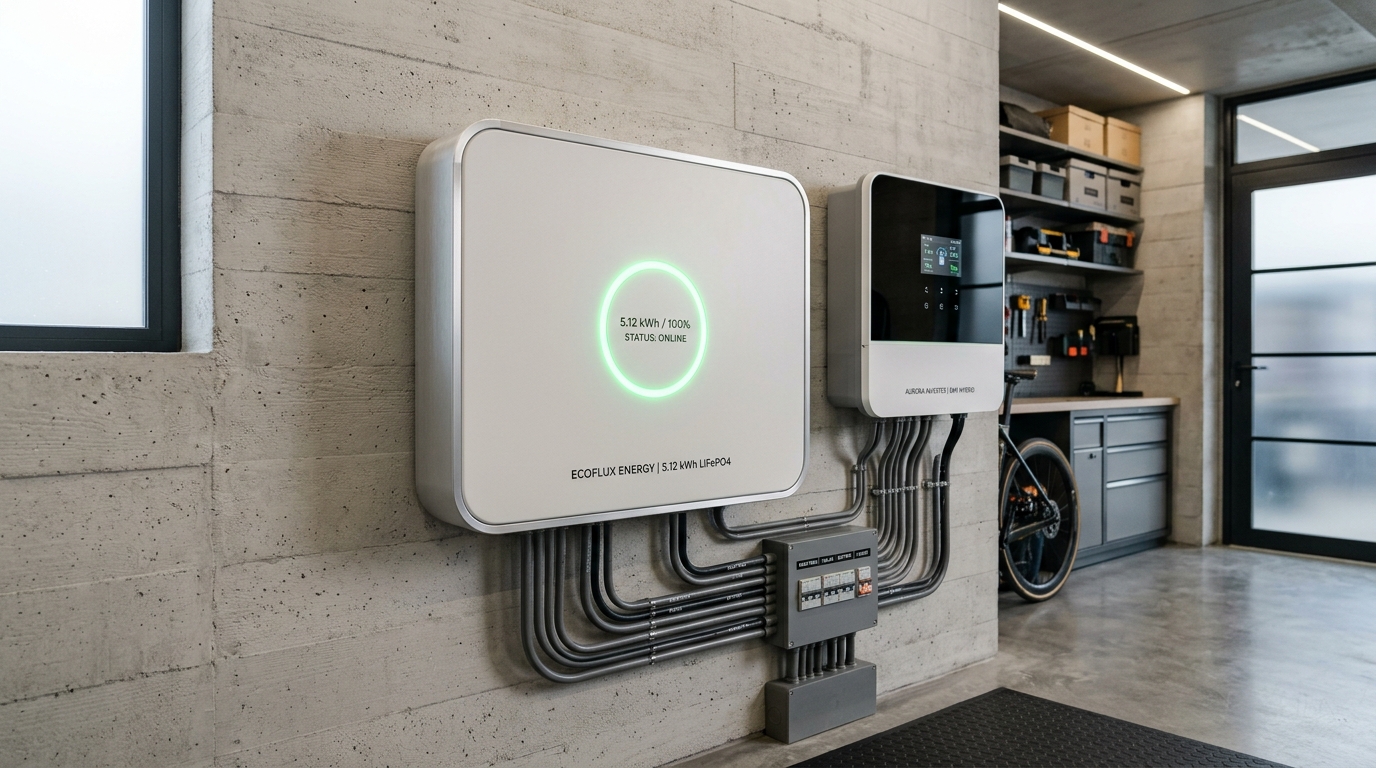
Wall-Mounted 5.12kWh & 10.24kWh 48V LiFePO4 Home Energy Storage Powerwall in Karachi.
Our commercial engineering division conducts comprehensive power quality audits, maximum demand indicators (MDI) analysis, and thermal load modeling to custom-engineer battery storage systems that maximize return on investment (ROI) within 3 to 4 years of continuous operation.
Commercial Energy Arbitrage & Diesel Fuel Displacement Economics
In Karachi’s commercial and industrial sectors, the financial return on a lithium batteryenergy storage system is propelled by two major cost-saving mechanisms:
Displacing Costly Diesel Generator Fuel: Operating a commercial diesel generator in Karachi currently costs between Rs. 85 and Rs. 110 per kilowatt-hour (kWh), factoring in fuel consumption (approximately 0.30 to 0.35 liters of diesel per kWh generated), frequent engine oil changes, fuel transport logistics, and maintenance labor. By contrast, charging our Grade-A LiFePO4 battery bank from daytime rooftop solar costs effectively Rs. 14 to Rs. 18 per kWh on a 10-year levelized basis. Displacing 4 hours of daily generator operation saves millions of Rupees annually in operational fuel expenditure.
K-Electric Peak-Hour Tariff Peak Shaving: K-Electric commercial and industrial tariff structures impose steep pricing on electricity consumed during evening peak hours (typically 5:00 PM to 10:00 PM / 6:00 PM to 11:00 PM), in addition to substantial Maximum Demand Indicator (MDI) charges. Our intelligent commercial BMS automatically orchestrates peak shaving: charging the battery bank from excess solar or off-peak grid power and discharging stored energy during peak hours, significantly lowering your monthly utility billing bracket.
19-Inch Server Rack & Containerized BESS Architecture
FWB Ventures commercial lithium systems are engineered using a modular, scalable architecture that grows with your business’s power requirements:
Modular 19-Inch 3U/4U Rack Modules: Standard commercial units are built in 5.12kWh (51.2V 100Ah) or 14.3kWh (51.2V 280Ah) rack-mount form factors. Multiple modules slide into standardized 19-inch telecom-grade server cabinets equipped with heavy-duty copper busbars, integrated DC disconnect breakers, and localized LED status indicators.
Scalability up to 32 Units in Parallel: Utilizing high-speed inter-battery CANbus daisy-chaining, up to 32 battery packs can operate under a centralized Master BMS, scaling low-voltage storage from 15kWh up to 163kWh without external controllers.
High-Voltage (HV) Series Architecture (400V–800V DC): For multi-megawatt industrial applications, we deploy high-voltage series strings utilizing centralized High-Voltage BMS Master Controllers. By raising operating voltage, transmission current is minimized, reducing I²R cabling heat losses and improving overall system round-trip efficiency above 96.5%.
Integrated Safety & Fire Suppression: Commercial enclosures feature built-in aerosol fire suppression systems (such as Stat-X or potassium nitrate generators) that automatically actuate in the event of abnormal thermal spikes, alongside integrated exhaust ventilation and high-speed semiconductor DC fuses.
Commercial Energy Storage System Specifications
Technical data for FWB Ventures commercial and industrial lithium series:
Specification Metric
15 kWh Commercial Rack
30 kWh Commercial Rack
50 kWh Industrial Bank
100 kWh Containerized BESS
Nominal Energy Capacity
15.36 kWh
30.72 kWh
51.20 kWh
102.40 kWh
Usable Energy (@ 90% DoD)
13.82 kWh
27.65 kWh
46.08 kWh
92.16 kWh
Nominal DC Bus Voltage
51.2 VDC (Low Voltage)
51.2 VDC (Low Voltage)
51.2V or 204.8V (HV)
409.6V to 614.4V (HV)
Continuous Charge / Discharge
150 A (7.5 kW)
300 A (15.0 kW)
500 A (25.0 kW)
100 A to 200 A @ HV
Cycle Life @ 80% Retention
6,000+ Cycles
6,000+ Cycles
6,000 to 8,000 Cycles
6,000 to 8,000 Cycles
Communication Protocols
CANbus, RS485, Modbus TCP
CANbus, RS485, Modbus TCP
CANbus, Modbus TCP, SNMP
SCADA, Modbus, Fiber Optic
Cooling & Thermal Control
Forced Air Exhaust Fans
Forced Air Exhaust Fans
Integrated Cabinet HVAC
Dedicated Container HVAC
Fire Suppression Integration
Optional Aerosol Pod
Optional Aerosol Pod
Automated Aerosol Extinguisher
Dual Aerosol + Novec 1230
Frequently Asked Questions About Commercial Energy Storage
How does a commercial lithium battery compare to running a diesel generator in Karachi?
Running a commercial generator in Karachi costs Rs. 85 to Rs. 110 per kWh in diesel and upkeep, causes noise pollution, emits noxious exhaust, and suffers a 15–30 second transfer lag. A commercial LiFePO4 battery bank paired with solar delivers stored energy at Rs. 14 to Rs. 18 per kWh levelized cost, operates completely silently with zero emissions, and switches over instantaneously (less than 10ms), keeping servers and CNC machines online without disruption.
Can this battery bank handle 3-phase heavy industrial motor starting loads?
Yes. When paired with commercial 3-phase hybrid inverters (such as Deye 12kW–50kW or Sungrow), our commercial battery banks easily handle heavy inductive motor starting currents up to 2 times continuous inverter capacity. The high-discharge Grade-A cells provide instantaneous surge current without triggering inverter low-voltage cutoffs.
What is the typical return on investment (ROI) payback period for a business in Karachi?
Most commercial enterprises in Karachi achieve full capital payback within 3.0 to 4.5 years. This payback is accelerated by high K-Electric peak-hour tariff savings, elimination of diesel fuel expenditure, and avoidance of factory downtime and damaged production batches.
Can our IT department monitor battery status remotely?
Yes. Our commercial BMS controllers support Modbus TCP, SNMP, and RS485 communication protocols, allowing seamless integration into your existing building management system (BMS), SCADA network, or local IT server dashboard for real-time monitoring of cell voltages, temperatures, charge rates, and historical logs.
Grade-A LiFePO4 Electrochemistry vs Conventional Lead-Acid in Karachi
Energy storage reliability in Karachi is heavily dictated by ambient operating temperature and depth of daily discharge. Traditional lead-acid batteries, including tubular deep-cycle and flooded OPzS cells, rely on sponge lead and lead dioxide submerged in sulfuric acid electrolyte. In Karachi’s prolonged summer climate, where battery room ambient temperatures frequently hover between 38°C and 44°C, lead-acid batteries undergo rapid positive grid corrosion, electrolyte dry-out, and active material shedding. When subjected to frequent daily K-Electric outage cycles, lead-acid batteries experience severe Peukert capacity loss, delivering less than 50% usable energy and failing within 18 to 24 months.
In contrast, FWB Ventures deploys automotive-grade Grade-A Lithium Iron Phosphate (LiFePO4) prismatic cells. The olivine crystal structure of LiFePO4 features robust covalent P-O chemical bonds that remain structurally stable up to 270°C, eliminating the risk of oxygen release and catastrophic thermal runaway inherent in nickel-manganese-cobalt (NMC) chemistries. Operating at a nominal cell potential of 3.2V (assembled into 4S for 12.8V, 8S for 25.6V, or 16S for 51.2V configurations), these cells exhibit negligible internal impedance (less than 0.5 milliohms per cell), supporting 1C continuous discharge without significant voltage drop.
Engineering Parameter
FWB Ventures Grade-A LiFePO4
Tubular Deep-Cycle Lead-Acid
NMC Lithium-Ion
Nominal Cell Voltage
3.2V (16S = 51.2V)
2.0V (6S = 12.0V)
3.7V (14S = 51.8V)
Cycle Life @ 80% DoD (25°C)
6,000 to 8,000 Cycles
800 to 1,200 Cycles
1,500 to 2,000 Cycles
Cycle Life @ 40°C (Karachi Summer)
4,500+ Cycles (12+ Years)
350 to 500 Cycles (1.5 Years)
900 to 1,200 Cycles
Recommended Depth of Discharge (DoD)
90% to 95%
50% Maximum
80%
Round-Trip Energy Efficiency
> 96%
70% to 75%
92%
Thermal Runaway Decomposition
270°C (Non-combustible)
Acid Boilage / Hydrogen Gas
150°C to 210°C (Fire Hazard)
Gravimetric Energy Density
130 to 160 Wh/kg
30 to 40 Wh/kg
180 to 250 Wh/kg
By migrating from heavy lead-acid blocks to our high-density LiFePO4 packs, residential and commercial consumers in Karachi eliminate acid spillages, sulfuric fume exposure, toxic corrosion of metal battery racks, and tedious bi-weekly distilled water maintenance routines.
The intelligence, cycle longevity, and operational safety of our lithium battery solutions are driven by an industrial-grade Battery Management System (BMS). Unlike basic analog balance boards or dumb battery monitors, our advanced BMS continuously samples voltage across every individual cell with 1-millivolt accuracy, monitors current via a precision bidirectional Hall-effect sensor or shunt, and tracks pack internal temperature through multi-point NTC thermistors placed between cell blocks and the power MOSFET heatsink.
The primary advantage for solar and UPS users across Karachi is our seamless closed-loop communication with Tier-1 hybrid and off-grid inverters. Rather than relying on inaccurate battery voltage estimation (open-loop lead-acid logic), our BMS broadcasts real-time parameters directly to the inverter microprocessor over CANbus (Controller Area Network) or RS485 communication lines:
Charge Voltage Limit (CVL): Dynamically requested by the BMS based on the highest cell voltage and internal temperature. When any individual cell reaches 3.65V, the BMS commands the inverter to lower charging current, preventing cell stress.
Discharge Current Limit (DCL): Automatically governed to prevent high current surges from exceeding safe cell discharge thresholds, especially when large inductive loads (such as 1.5-ton inverter air conditioners or water pumping motors) start up.
State of Charge (SoC) Coulomb Counting: High-precision integration of ampere-hours into and out of the battery bank ensures true 0% to 100% capacity display, eliminating the notorious "voltage bounce" that causes lead-acid UPS units to shut down prematurely.
Inverter Compatibility Ecosystem: Pre-configured protocols support Deye (Sun-3K to 12K-SG04LP3 / SG01LP1), Solis, Sungrow, GoodWe, Growatt (SPF/SPH), Inverex Nitrox / Veyron, InfiniSolar, Huawei, and Voltronic Axpert architectures.
In addition to inverter closed-loop orchestration, the BMS features dual-layer electronic and hardware protection. An automated short-circuit disconnect breaks current flow in less than 200 microseconds, safeguarding cell interconnect busbars and inverter DC capacitors from damaging faults.
Karachi presents a demanding environmental challenge for electrical energy storage systems. Properties in DHA Phases 1 through 8, Clifton, Keamari, and Korangi Creek operate in a hyper-saline marine atmosphere characterized by continuous ocean humidity, salt-fog mist, and airborne chloride deposits. Unprotected battery terminals, standard steel enclosures, and unsealed circuit boards experience galvanic corrosion, contact resistance buildup, terminal overheating, and premature BMS microprocessor failure.
FWB Ventures engineers every lithium battery enclosure with multi-stage environmental hardening:
Cold-Rolled Steel with Electrostatic Powder Coating: Robust 1.5mm cold-rolled steel enclosures undergo zinc phosphatizing followed by an outdoor-grade electrostatic polyester powder coat, passing 500-hour ASTM B117 salt-spray corrosion tests.
Marine-Grade Brass & Nickel-Plated Copper Terminals: High-amperage M8 terminal studs are machined from solid brass and nickel-plated to prevent oxidation, accompanied by flame-retardant insulating terminal boots.
Conformal-Coated BMS Circuitry: All internal BMS printed circuit boards are coated with a dual-layer siliconized moisture-proof, anti-fungal, and anti-static conformal sealant, insulating delicate microchips from marine humidity.
Thermal Dissipation & Karachi Ambient Cooling: Ambient temperatures in Karachi frequently surpass 42°C during April to October. Our wall-mounted Powerwalls and 19-inch rack enclosures incorporate passive vertical convection heat-sinking channels paired with whisper-quiet, dual ball-bearing exhaust fans. The BMS maintains an active high-temperature charge cut-off at 55°C and discharge cut-off at 65°C, ensuring absolute safety under the most severe peak heat conditions.
Professional Commissioning, DC Circuit Protection & Cable Sizing Standards
A high-performance lithium battery bank requires precision electrical engineering at the point of installation. Lithium cells possess extremely low internal resistance, which means a direct short circuit or improper cable termination can release immense fault currents within milliseconds. FWB Ventures enforces rigorous engineering standards across all Karachi residential and commercial installations:
Pure Copper Ultra-Flexible DC Cables: We utilize double-insulated, oxygen-free 100% pure copper cables with Class 5 or Class 6 flexible stranding (rated to 1,000V DC and 105°C). Cable gauges are engineered to maintain voltage drop below 1% at maximum continuous current:
For 12V 100Ah/200Ah systems (up to 100A discharge): 25mm² to 35mm² pure copper cabling.
For 24V 100Ah/200Ah systems (up to 120A discharge): 35mm² to 50mm² pure copper cabling.
For 48V/51.2V 100Ah/200Ah systems (up to 150A discharge): 50mm² to 70mm² pure copper cabling.
Heavy-Duty Hydraulic Hexagonal Crimping: All cable lugs are tinned copper heavy-duty bell-mouth terminals, crimped using calibrated 12-ton hydraulic tools and sealed with polyolefin flame-retardant dual-wall heat-shrink tubing containing internal adhesive glue.
Dedicated DC Isolation & Overcurrent Protection: Every battery bank is installed with a polarized DC Molded Case Circuit Breaker (MCCB) or high-speed Class aR semiconductor fuse (such as Bussmann or Schneider Electric DC isolators rated at 125A, 160A, or 250A DC). This ensures fast galvanic disconnection in emergency conditions without drawing an electric arc.
Busbar Paralleling & Multi-Pack Current Balance: When paralleling multiple 5.12kWh rack batteries or Powerwalls (scalable up to 16 units for 81.92kWh total capacity), FWB Ventures installs an engineered central DC busbar cabinet. Diagonal connection topology ensures identical cable loop resistance across all parallel strings, preventing one battery pack from carrying disproportionate load.
10-Year Levelized Cost of Storage (LCOS) vs Lead-Acid Economics in Pakistan
While the upfront purchase price of a LiFePO4 battery pack is higher than conventional flooded or tubular lead-acid batteries, a rigorous Levelized Cost of Storage (LCOS) financial assessment demonstrates that lithium is substantially cheaper over a 5 to 10-year operating horizon in Karachi.
Consider a standard residential solar or UPS setup requiring 4.8 kWh of usable nighttime storage:
Economic Factor
Tubular Lead-Acid Bank (4x 200Ah 12V)
FWB Ventures 51.2V 100Ah LiFePO4
Nominal Bank Capacity
9.60 kWh (4x 12V 200Ah)
5.12 kWh (1x 51.2V 100Ah)
Usable Energy (@ Safe DoD)
4.80 kWh (50% DoD limit)
4.61 kWh (90% DoD standard)
Expected Lifespan in Karachi Heat
2.0 to 2.5 Years (800 cycles)
12 to 15 Years (6,000+ cycles)
Initial Capital Outlay (PKR)
Rs. 240,000 (Rs. 60,000 x 4)
Rs. 275,000 to Rs. 295,000
Replacements Needed in 10 Years
4 to 5 Complete Replacements
0 (Zero Replacements)
10-Year Battery Acquisition Cost
Rs. 960,000 to Rs. 1,200,000
Rs. 275,000 to Rs. 295,000
10-Year Electricity Charging Losses
Rs. 185,000 (25% round-trip loss)
Rs. 30,000 (4% round-trip loss)
Distilled Water & Maintenance Costs
Rs. 48,000 (Monthly top-ups)
Rs. 0 (Completely Maintenance-Free)
Total 10-Year Cost of Ownership
Rs. 1,193,000+
Rs. 305,000 to Rs. 325,000
Net Financial Savings with Lithium
Rs. 868,000+ Saved per 5kWh Storage Block Over 10 Years
When evaluated over a 10-year timeframe, investing in FWB Ventures Grade-A LiFePO4 batteries reduces total energy storage expenditure by more than 70%. In addition to pure monetary savings, homeowners and commercial enterprises avoid the frustration of sudden battery failures in the middle of summer heatwaves.
Our certified engineers inspect your rooftop structural load capacity, perform drone 3D shadow simulation, and evaluate existing K-Electric IBC billing meter specs.
2
Precision Engineering & Frame Fabrication
We design custom hot-dip galvanized mounting structures rated for 140+ km/h coastal winds and build electrical Single-Line Diagrams (SLDs) for KE compliance.
3
Installation & Net Metering Commissioning
Professional panel clamping, pure copper earthing boring (<5 ohms), DC surge protection, and end-to-end K-Electric green bidirectional meter commissioning.
4
24/7 Mobile Telemetry & Lifetime Support
Real-time smartphone monitoring app setup, battery health management, periodic panel cleaning protocols, and fast-response maintenance across Karachi.
Karachi-Wide Coverage
Turnkey Services Across All Karachi Districts & Industrial Zones
Our certified EPC engineering teams deploy daily across all key residential, commercial, and industrial hubs in Karachi:
DHA Karachi
Phases 1 to 8 & Ext
Clifton Karachi
Blocks 1 to 9 & Sea View
Gulshan-e-Iqbal
Blocks 1 to 19 & University Rd
Gulistan-e-Johar
Blocks 1 to 20 & Pehlwan Goth
North Nazimabad
Blocks A to W & Hyderi
PECHS & Tariq Rd
Blocks 2, 3, 6 & Khalid Bin Waleed
Korangi Industrial Area
Sector 7A to 32 & Creek
SITE Industrial Area
Heavy Industrial Estate
Scheme 33 & Malir Cantt
Super Highway Societies
Federal B Area
Blocks 1 to 22 & Yaseenabad
Port Qasim & Landhi
Export Processing Zone
Bahria Town Karachi
Precincts 1 to 35
Cross-Discipline Solutions
FWB Ventures 4 Engineering Divisions
Integrate our turnkey clean energy, mounting fabrication, security surveillance, and battery storage services for maximum property value and security.