K-Electric Approved Solar Systems by Type in Karachi • Tier-1 EPC Engineering in Karachi
FWB Ventures is Karachi's trusted EPC contractor for Solar Systems by Type in Karachi. We deliver turnkey Tier-1 PV installations, heavy hot-dip galvanized mounting frames, certified K-Electric net metering, and 24/7 technical monitoring across Sindh.
1. Comprehensive Engineering Overview: Solar Systems by Type in Karachi
In the dynamic energy landscape of Karachi, investing in Solar Systems by Type in Karachi represents the most economically robust and technologically advanced strategy to achieve energy sovereignty. With commercial and residential electricity tariffs from K-Electric (KE) consistently climbing above PKR 65 to PKR 75 per kilowatt-hour (kWh)—when factoring in base tariffs, Fuel Charges Adjustments (FCA), Quarterly Tariff Adjustments (QTA), and supplementary surcharges—property owners and commercial enterprises across Karachi are transitioning to high-efficiency solar energy systems. FWB Ventures delivers end-to-end turnkey engineering, procurement, and construction (EPC) services tailored specifically to Karachi’s unique subtropical coastal climate, high solar irradiance patterns, and localized electrical grid dynamics.
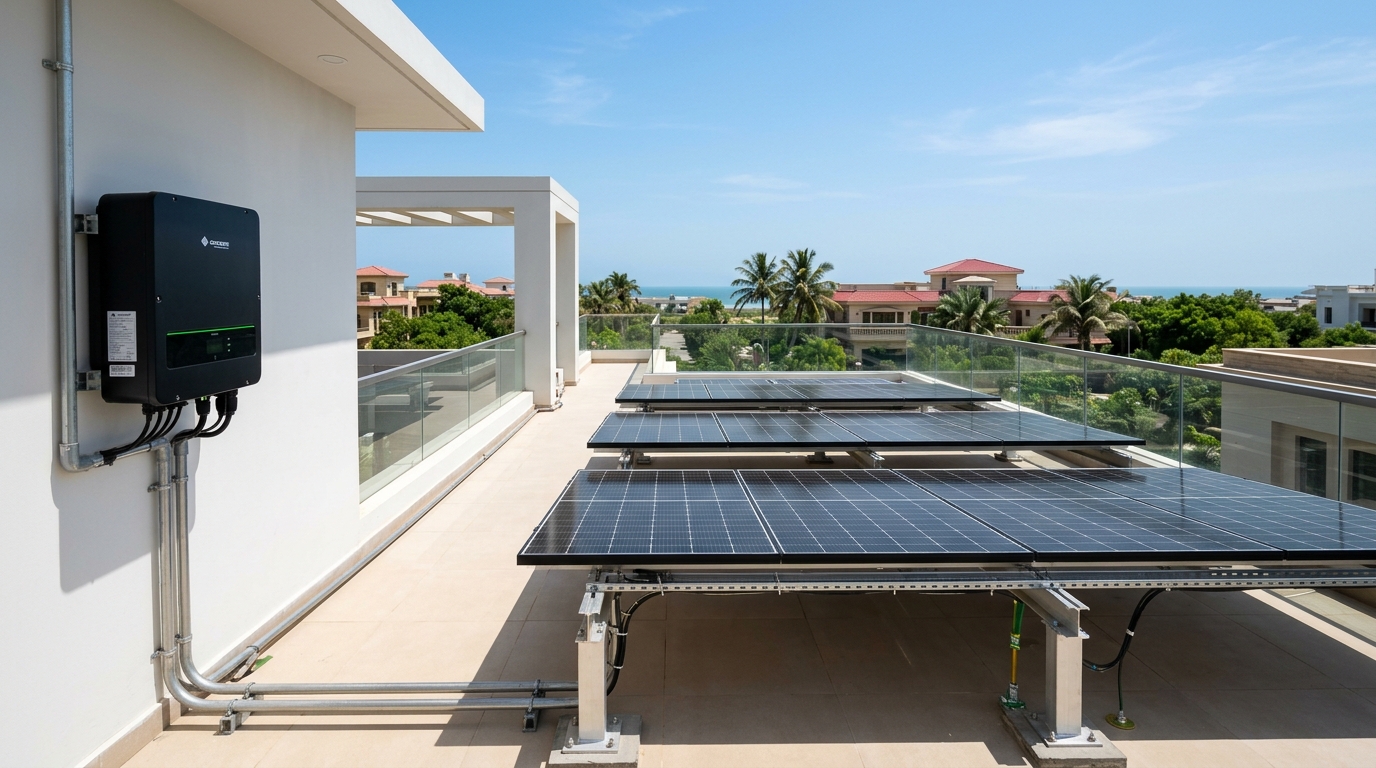
High-Efficiency Tier-1 Residential Rooftop Solar Panel Installation in Karachi.
Karachi receives an extraordinary annual solar bounty, averaging between 5.2 and 5.8 peak sun hours per day, with global horizontal irradiance (GHI) exceeding 1,950 kWh/m² per annum. However, capturing this abundant solar resource effectively demands an engineering approach that accounts for Karachi’s harsh ambient realities: high relative humidity averaging 70% to 85% in coastal zones like DHA and Clifton, heavy airborne marine salt aerosols, intense summer ambient temperatures frequently exceeding 42°C, and seasonal particulate dust accumulation across industrial zones such as SITE, Korangi, Landhi, and Port Qasim. Our Solar Systems by Type in Karachi installations are purpose-engineered with certified Tier-1 photovoltaic modules, corrosion-proof hot-dip galvanized mounting frames, advanced switchgear protection, and intelligent inverter topologies that ensure maximum kilowatt-hour generation year after year.
Understanding the Technical Architecture of Solar Systems by Type in Karachi
Every photovoltaic system engineered by FWB Ventures is tailored to solve specific consumer challenges. Whether your priority is completely zeroing your monthly K-Electric electricity bill through bi-directional net metering, securing seamless uninterruptible power during distribution grid outages, or establishing absolute off-grid autonomy for an agricultural farmhouse on the outskirts of Karachi, understanding the core mechanical and electrical architecture of your system is paramount.
The primary subsystems comprising our Solar Systems by Type in Karachi include:
Photovoltaic Generation Array: Utilizing BloombergNEF (BNEF) Tier-1 rated N-Type TOPCon (Tunnel Oxide Passivated Contact) or Bifacial Monocrystalline silicon modules (580W to 615W+ capacity per panel) boasting module conversion efficiencies exceeding 22.5% and lower temperature coefficients (-0.30%/°C) to withstand Karachi’s scorching summer heat waves.
Power Conversion Subsystem: Incorporating All Topology Inverters (On-Grid, Hybrid, Off-Grid) featuring multi-channel Maximum Power Point Trackers (MPPT), wide DC operating voltage windows, integrated DC arc-fault circuit interrupters (AFCI), and high-frequency digital signal processor (DSP) controls.
Structural Mounting Infrastructure: FWB Ventures' hallmark custom-fabricated heavy hot-dip galvanized steel frames (≥ 85 μm zinc coating conforming to ASTM A123 / ISO 1461), custom-engineered to withstand coastal wind gusts of up to 150 km/h without mechanical fatigue or corrosion.
Energy Storage Integration (where applicable): Scalable Grid and Battery Energy Storage Options utilizing safe, thermally stable Lithium Iron Phosphate (LiFePO4) chemistry with intelligent Battery Management Systems (BMS) communicating over CANbus / RS485 protocols.
Electrical Balance of System (BoS): Class-II double-insulated UV-resistant solar photovoltaic cables (4mm² / 6mm² pure tinned electrolytic copper), Type-II DC surge protection devices (SPDs), ABB/Schneider AC miniature circuit breakers (MCBs), IP66 polycarbonate combiner enclosures, and dual chemical earthing pits ensuring earth loop impedance < 3 Ω.
---
2. Detailed Performance Comparison: Solar System Topologies in Karachi
Selecting the correct system typology dictates your initial capital expenditure (CAPEX), operational simplicity, battery replacement lifecycle, and overall Return on Investment (ROI). The following engineering comparison matrix illustrates how Solar Systems by Type in Karachi compares against alternative configurations operating within the K-Electric grid jurisdiction:
System Metric / Feature
On-Grid (Grid-Tied)
Hybrid (Solar + Storage)
Off-Grid (Standalone)
Primary Objective
Maximum bill reduction & K-Electric unit export
Bill offset + 24/7 seamless load-shedding backup
Total energy independence without utility grid
K-Electric Net Metering
Fully Compatible (100% Export)
Fully Compatible (Surplus Export)
Not Applicable (Isolated)
Blackout Performance
Shuts down (Anti-Islanding Safety)
Instant Switchover (<10ms UPS grade)
Continuous 24/7 Autonomous Supply
Battery Storage Requirement
None required (Lowest upfront cost)
LiFePO4 Lithium Batteries (Scalable)
Mandatory Heavy Storage Capacity
Typical Payback Period (ROI)
2.2 – 2.8 Years
2.8 – 3.4 Years
3.5 – 4.5 Years
Levelized Cost of Energy (LCOE)
PKR 5.50 – 7.20 / kWh
PKR 8.50 – 11.50 / kWh
PKR 14.00 – 18.00 / kWh
Maintenance Demands
Minimal (Panel cleaning & annual check)
Low (Automated BMS cell monitoring)
Moderate (Battery state of charge tracking)
---
3. K-Electric Net Metering Regulations, Billing Economics & NEPRA Compliance
A fundamental component of maximizing the economic returns of Solar Systems by Type in Karachi in Karachi is the regulatory framework governed by the National Electric Power Regulatory Authority (NEPRA) under S.R.O. 892(I)/2015 and executed locally through K-Electric’s Distributed Generation Facilitation Centers across Karachi's 31+ Integrated Business Centers (IBCs).
How K-Electric Net Metering Works in Practice
Net metering allows commercial and residential solar power producers to establish a bi-directional electricity flow with K-Electric. During peak daylight hours (typically between 9:00 AM and 4:30 PM in Karachi), your solar array generates substantial excess kilowatt-hours above your immediate building consumption. Instead of wasting this surplus energy or over-investing in oversized battery banks, the excess energy is automatically pushed through a bi-directional green digital meter back into K-Electric's 11kV/400V distribution grid.
The financial mechanics function as follows:
Unit-for-Unit Offsetting: Every kilowatt-hour exported to K-Electric offsets a unit consumed from the utility during evening hours or cloudy days.
Off-Peak Tariff Arbitrage: For residential and commercial three-phase consumers, solar generation during daytime hours directly offsets expensive off-peak domestic and commercial units (currently priced between PKR 60 and PKR 72 per unit when including fuel adjustment and general sales taxes).
Surplus Banked Units: If your monthly export exceeds your monthly consumption, K-Electric banks the net credit units into your account, rolling them over to subsequent billing months or settling them quarterly at the applicable NEPRA-notified national export tariff.
Step-by-Step K-Electric Net Metering Process Handled by FWB Ventures
Navigating utility procedures in Karachi requires precise documentation and engineering compliance. FWB Ventures provides complete end-to-end liaison, eliminating administrative delays:
Sanctioned Load Verification: We verify your existing K-Electric sanctioned load on your latest electricity bill. Under NEPRA rules, distributed generation capacity can be installed up to 1.5 times the sanctioned load. If an increase is necessary, we file the official load enhancement application on your behalf.
Single Line Diagram (SLD) Certification: Our in-house Pakistan Engineering Council (PEC) registered professional electrical engineers draft comprehensive Single Line Diagrams detailing anti-islanding schemes, cable sizing, earthing layout, and breaker ratings conforming strictly to KE Technical Standards.
Equipment Type Approval: We submit verifiable flash test reports, IEC 61215/61730 certificates for solar panels, and IEC 62109 / VDE-AR-N 4105 compliance certificates for grid-tied inverters.
Field Inspection & Grid Synchronization: We coordinate the on-site physical inspection with the regional K-Electric Energy Conservation and Distributed Generation team, supervise anti-islanding trip testing, and oversee the installation and sealing of the bi-directional green meter.
A solar power system is only as durable as the structural framework supporting it. Karachi’s geographical positioning along the Arabian Sea coast exposes rooftop structures to an aggressive combination of saline humidity, atmospheric sulfur dioxide, high UV radiation, and intense seasonal wind shear. Standard painted steel, electroplated angles, or lightweight 14-gauge channels commonly sold by budget installers inevitably corrode, weaken, and fail within 2 to 4 years, putting valuable solar panels and roof integrity at immense risk.
FWB Ventures Structural Manufacturing Standard
Every solar mounting frame engineered by FWB Ventures undergoes full-immersion Hot-Dip Galvanization conforming strictly to ASTM A123 / ISO 1461 standards. Fabricated using high-yield structural mild steel (minimum 12-gauge / 2.5mm to 3.0mm thickness), our frames receive a zinc coating thickness exceeding 85 microns (610 g/m²). This provides self-healing sacrificial cathodic protection that prevents rust and corrosion for 25+ years, even in high-salinity coastal neighborhoods such as DHA Phases 1 through 8, Clifton, and Port Qasim.
Structural Configurations Engineered for Karachi Rooftops
FWB Ventures designs and fabricates three primary structural profiles to accommodate different roof architectures and aesthetic preferences:
L2 / L3 Low Profile Standard Mounting: Optimized for non-accessible flat concrete rooftops and commercial metal roofs. Engineered at a fixed 24° to 26° true south tilt angle, providing maximum annual energy yield while minimizing wind uplift cross-section.
Elevated Solar Pergola & Gazebo Frames (7.5 ft to 9.0 ft Clear Height): Designed specifically for luxury residential bungalows in DHA, Clifton, PECHS, and Gulshan-e-Iqbal. These heavy box-column structures elevate the solar array overhead, completely preserving 100% of the rooftop terrace floor area for family seating, evening recreation, gardens, and clothes drying.
Solar Carport Canopies: Ideal for corporate office parking areas, commercial plazas, and industrial vehicle sheds. Heavy structural I-beams and galvanized purlins create watertight covered parking while generating hundreds of kilowatt-hours of clean solar power overhead.
All module fasteners, end clamps, mid clamps, and structural bolts utilize Marine-Grade Stainless Steel (SS304 / SS316) with specialized EPDM rubber separation gaskets. This critical engineering detail eliminates galvanic corrosion between dissimilar metals (aluminum panel frames and galvanized steel purlins), ensuring structural integrity for over three decades.
---
5. Tier-1 Hardware Specifications: Solar Panels, Inverters & Switchgear
To deliver our guaranteed performance ratio of 78% to 82% under real-world Karachi operating conditions, FWB Ventures partners exclusively with globally bankable, BloombergNEF Tier-1 manufacturers. We strictly reject smuggled, B-grade, relabeled, or refurbished components.
1. High-Efficiency Solar Photovoltaic Modules
Technology: Monocrystalline N-Type TOPCon and P-Type Bifacial Double-Glass modules (580W to 615W+).
Leading Brands Supplied: Longi Solar (Hi-MO 6 / Hi-MO X6), Jinko Solar (Tiger Neo), Canadian Solar (TopBiHiKu6), and JA Solar (DeepBlue 4.0 Pro).
Key Parameters: Cell efficiency exceeding 22.5%, temperature coefficient of Pmax as low as -0.30%/°C, 12-year manufacturer product warranty, and 30-year linear power output warranty guaranteeing ≥ 87.4% generation at year 30.
2. Intelligent String & Hybrid Inverters
Leading Brands Integrated: Huawei (FusionSolar SUN2000 series), Sungrow, Solis, GoodWe, and Deye Hybrid multi-mode inverters.
Key Parameters: Maximum conversion efficiency up to $98.8\%$, multiple independent MPPT trackers with 99.9% dynamic MPPT efficiency, built-in DC disconnect switches, IP65/IP66 weatherproofing, and smart cloud Wi-Fi/4G telemetry providing real-time smartphone monitoring.
DC Protection: Dedicated DC disconnect isolators (1000V/1500V DC rated) and Type-II DC Surge Protective Devices (SPDs) from Schneider Electric, Chint, or Suntree to divert high-voltage atmospheric surges.
AC Switchgear: High-rupturing-capacity miniature circuit breakers (MCBs) and molded-case circuit breakers (MCCBs) matched precisely to the full-load inverter output current and K-Electric utility feed impedance.
Earthing Infrastructure: Two physically segregated chemical earth pits bored 30 to 50 feet deep. We utilize solid 99.9% electrolytic copper grounding rods surrounded by conductive bentonite/marconite moisture-retention chemical backfill, achieving a verified earth loop resistance of less than $3\,\Omega$.
---
6. Turnkey EPC Installation Lifecycle by FWB Ventures
Every Solar Systems by Type in Karachi executed by FWB Ventures adheres to a rigorous 6-stage engineering and project management methodology:
Step 1: 3D Rooftop Survey & Shading Analysis
On-site laser measurement of parapet walls, water overhead tanks, stair towers, and adjacent buildings. Computerized 3D solar shade modeling using PVsyst and Helioscope to calculate precise irradiance profiles and eliminate panel mismatch losses.
Step 2: Electrical Engineering & SLD Design
Detailed CAD electrical layout, string voltage calculation (V_oc open circuit voltage at Karachi winter minimum temperatures), cable voltage drop minimization (< 1.5%), and breaker selectivity coordination certified by PEC registered engineers.
Step 3: Structural Stand Fabrication & Chemical Anchoring
Heavy hot-dip galvanized steel fabrication with precision baseplates anchored to rooftop concrete columns using certified high-load chemical injection anchors (Hilti / Fischer), preserving complete roof waterproofing.
Step 4: Precision Module Mounting & DC Cabling
Panels secured with torque-calibrated SS304 clamps. DC cabling routed through heavy-gauge UV-stabilized PVC conduits, dressed neatly with heavy-duty nylon ties, and crimped using genuine MC4 solar connectors.
Step 5: Testing, Commissioning & Earth Loop Audit
Pre-commissioning electrical testing including string open-circuit voltage (V_oc) verification, polarity check, DC insulation resistance testing (megger test), phase rotation checks, and earth resistance measurement (< 3 Ω).
Step 6: K-Electric Green Meter Handover & Cloud Setup
Coordination with K-Electric IBC for green meter testing and synchronization. Configuration of customer smartphone application for live daily generation, battery state-of-charge, and historical export analytics.
---
7. Financial Modeling, Tariff Savings & Return on Investment (ROI)
Investing in Solar Systems by Type in Karachi in Karachi delivers unparalleled capital returns that dramatically outpace traditional banking instruments, real estate rental yields, or mutual funds. Under current macroeconomic conditions in Pakistan, characterized by elevated inflation and soaring K-Electric fuel adjustment charges, a solar EPC investment functions as a powerful financial hedge.
Illustrative Financial Model for a Standard 10kW System in Karachi
Average Daily Generation: 40 to 45 kWh (units) per day in Karachi.
Average Monthly Generation: 1,200 to 1,350 kWh (units) per month.
Annual Electricity Yield: 14,400 to 16,200 kWh per year.
Average Blended K-Electric Tariff: PKR 68 per unit (including taxes, FCA, and surcharges).
Gross Monthly Bill Savings: PKR 81,600 to PKR 91,800 per month.
Gross Annual Financial Savings: PKR 979,200 to PKR 1,101,600 per year.
Estimated Turnkey Capital Investment: PKR 1,350,000 to PKR 1,650,000 (depending on mounting frame height and inverter brand).
Simple Payback Period:1.4 to 1.8 Years!
Remaining 23+ Years of Operation: Virtually free electricity yielding over PKR 25,000,000 in cumulative net savings over the system’s warrantied 25-to-30 year lifespan.
---
8. Frequently Asked Questions (FAQs) About Solar Systems by Type in Karachi
Q1: How much roof space do I need for Solar Systems by Type in Karachi in Karachi?
Standard Tier-1 580W to 610W panels require approximately 70 to 80 square feet of shadow-free rooftop area per kilowatt (kW). For example, a 5kW system requires approximately 350 to 400 sq. ft., while a 10kW installation requires 700 to 800 sq. ft. If you opt for an elevated pergola structure, the terrace ground space below remains 100% usable.
Q2: Will Solar Systems by Type in Karachi keep my home powered during K-Electric load-shedding?
If you install a Hybrid Solar System or a system configured with LiFePO4 battery backup, your power will remain completely uninterrupted with an automatic switchover time of under 10 milliseconds (imperceptible to computers, Wi-Fi routers, and ACs). Standard On-Grid systems shut down during utility outages for safety reasons (anti-islanding) unless coupled with battery storage.
Q3: How long does the K-Electric Net Metering process take in Karachi?
When managed by FWB Ventures, the complete turnkey net metering process—from initial application filing and PEC-certified Single Line Diagram (SLD) submission to K-Electric inspection and bi-directional green meter installation—typically takes between 4 to 8 weeks depending on the regional K-Electric IBC.
Q4: Why are hot-dip galvanized mounting structures essential in Karachi?
Karachi’s coastal air carries high salt concentrations that corrode normal painted or electroplated iron stands in less than 24 months. FWB Ventures uses full-immersion hot-dip galvanized steel frames (≥ 85 μm zinc coating, ASTM A123) and SS304 marine fasteners, providing 25+ years of rust-free stability rated for 150 km/h coastal winds.
Q5: How often do solar panels need cleaning in Karachi?
Due to Karachi’s airborne dust and urban particulate matter, we recommend washing solar panels with plain de-ionized or soft water once every 2 to 3 weeks during dry months. Regular cleaning preserves optimal generation and prevents a 10% to 18% efficiency drop caused by soiling.
---
9. Related Solar Services & Cross-Industry Solutions
FWB Ventures is your integrated one-stop engineering partner across Karachi. Explore our complementary service divisions to maximize property value, security, and energy resilience:
Full K-Electric Net Metering Liaison Across All Karachi IBCs
Dual Chemical Earthing Pits with Pure Copper Rods (< 3 Ohms)
Complete 25-Year Linear Power Warranty & Dedicated Karachi SLA Support
Commercial & Operational Advantages
Why Karachi Property Owners Choose FWB Ventures
Eliminate up to 90% of your monthly K-Electric electricity bill
Hedge against rising utility tariffs, fuel adjustments, and inflation
Achieve an attractive capital payback in approximately 2.2 to 3.5 Years
Engineered specifically for coastal wind shear (150 km/h) and salt air
How We Deliver
Our 4-Step Turnkey EPC & Installation Process
1
On-Site Audit & 3D Shading Simulation
Our certified engineers inspect your rooftop structural load capacity, perform drone 3D shadow simulation, and evaluate existing K-Electric IBC billing meter specs.
2
Precision Engineering & Frame Fabrication
We design custom hot-dip galvanized mounting structures rated for 140+ km/h coastal winds and build electrical Single-Line Diagrams (SLDs) for KE compliance.
3
Installation & Net Metering Commissioning
Professional panel clamping, pure copper earthing boring (<5 ohms), DC surge protection, and end-to-end K-Electric green bidirectional meter commissioning.
4
24/7 Mobile Telemetry & Lifetime Support
Real-time smartphone monitoring app setup, battery health management, periodic panel cleaning protocols, and fast-response maintenance across Karachi.
Karachi-Wide Coverage
Turnkey Services Across All Karachi Districts & Industrial Zones
Our certified EPC engineering teams deploy daily across all key residential, commercial, and industrial hubs in Karachi:
DHA Karachi
Phases 1 to 8 & Ext
Clifton Karachi
Blocks 1 to 9 & Sea View
Gulshan-e-Iqbal
Blocks 1 to 19 & University Rd
Gulistan-e-Johar
Blocks 1 to 20 & Pehlwan Goth
North Nazimabad
Blocks A to W & Hyderi
PECHS & Tariq Rd
Blocks 2, 3, 6 & Khalid Bin Waleed
Korangi Industrial Area
Sector 7A to 32 & Creek
SITE Industrial Area
Heavy Industrial Estate
Scheme 33 & Malir Cantt
Super Highway Societies
Federal B Area
Blocks 1 to 22 & Yaseenabad
Port Qasim & Landhi
Export Processing Zone
Bahria Town Karachi
Precincts 1 to 35
Cross-Discipline Solutions
FWB Ventures 4 Engineering Divisions
Integrate our turnkey clean energy, mounting fabrication, security surveillance, and battery storage services for maximum property value and security.