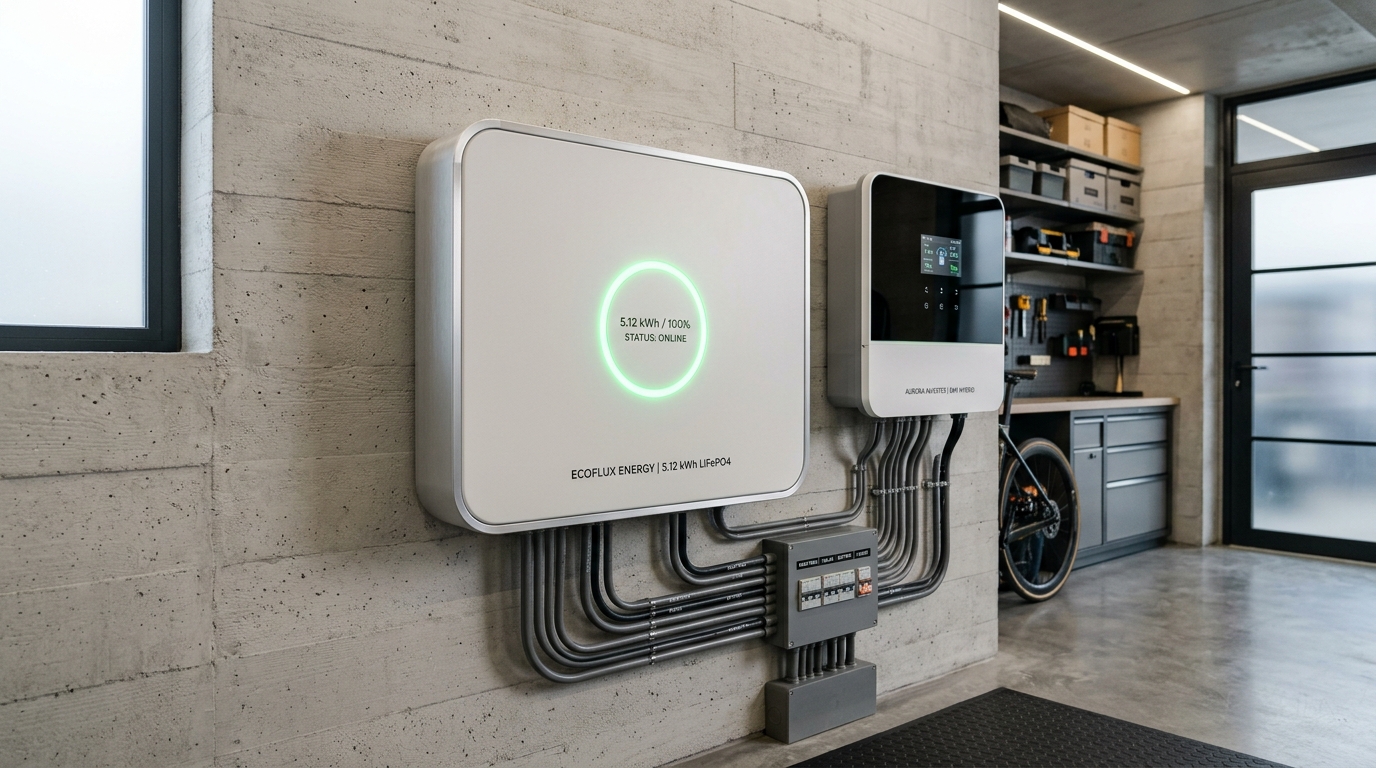
Ultra-Safe Grade-A LiFePO4 Home Energy Storage with 6,000+ Cycles for Karachi Residences
FWB Ventures supplies and installs high-performance Lithium Battery for Home Backup in Karachi. Featuring 6,000+ cycles, closed-loop inverter communication, zero acid maintenance, and reliable home power during blackouts.
FWB Ventures offers comprehensive Lithium Battery for Home Backup solutions engineered to protect Karachi homes from rising electricity tariffs, unpredictable K-Electric load-shedding, and frequent voltage fluctuations. Utilizing certified Grade-A Lithium Iron Phosphate (LiFePO4) technology, our home energy storage systems deliver uncompromised safety, ultra-fast charging, and over 6,000 cycle lifespans.
Wall-Mounted 5.12kWh & 10.24kWh 48V LiFePO4 Home Energy Storage Powerwall in Karachi.
Whether you are upgrading an existing household UPS or commissioning a high-end hybrid solar system for your DHA or Bahria Town residence, our certified solar electrical engineers design, size, install, and commission your battery storage system to achieve maximum solar self-consumption and 24/7 power security.
Real-World Appliance Runtime Analysis in Karachi
Understanding exactly how long your household appliances will operate on a single charge is essential when selecting a lithium battery. Below is an engineered runtime estimation chart for common Karachi residential load scenarios across our core battery capacities:
Summer Cooling: 1.5-Ton Inverter AC (@ 26°C) + Home Essentials
1,400 W (Avg)
Not Recommended
1.6 Hours
3.3 Hours
6.6 Hours
Full Villa: Dual 1.5-Ton Inverter ACs + Full Home Load
2,600 W (Avg)
Not Recommended
Not Recommended
1.7 Hours
3.5 Hours
*Calculations assume 90% Depth of Discharge and a 93% inverter conversion efficiency. Inverter air conditioner power consumption assumes steady-state compressor operation at 26°C setpoint in standard room insulation.
Why LiFePO4 Outperforms Lead-Acid on Heavy Household Inductive Loads
Inverter air conditioners, domestic water transfer pumps, and refrigerator compressors represent inductive loads that require sudden inrush starting currents up to 3 to 5 times their running wattage. When an inductive motor kicks on:
The Lead-Acid Defect: Lead-acid batteries have relatively high internal resistance (10 to 30 milliohms). Under a sudden 1,500W load spike, battery terminal voltage plunges instantly from 12.6V to below 10.5V. The household inverter interprets this voltage dip as a dead battery and triggers a low-voltage shutdown alarm—even if the battery was at 80% charge!
The LiFePO4 Advantage: Our Grade-A LiFePO4 cells feature ultra-low internal resistance (under 0.5 milliohms per cell). When the compressor starts up, the pack delivers instant peak current without noticeable voltage drop, allowing your inverter to run air conditioners and water pumps smoothly without nuisance tripping.
Rapid Daytime Solar Recharging: Lead-acid batteries require a slow 8 to 10-hour absorption charge cycle to avoid boiling electrolyte. If grid power is only available for 3 hours between load-shedding intervals, lead-acid batteries remain perpetually undercharged and rapidly sulfate. FWB Ventures LiFePO4 batteries accept up to 0.5C to 1C charge rates, reaching 100% full capacity within just 2 to 2.5 hours of sunlight or grid power.
Frequently Asked Questions About Lithium Battery for Home Backup
Is a lithium battery safe to keep inside an apartment or living room in Karachi?
Absolutely. Unlike flooded or tubular lead-acid batteries, our LiFePO4 batteries are 100% sealed, non-toxic, and emit zero hydrogen gas or corrosive acid vapors. Furthermore, Lithium Iron Phosphate chemistry is chemically non-combustible and will not explode or enter thermal runaway even if accidentally punctured or exposed to extreme heat.
Can I run my 1.5-ton inverter air conditioner on a 5.12kWh lithium battery?
Yes. A modern 1.5-ton DC inverter AC consumes approximately 1,100W to 1,400W initially and settles around 700W to 900W once the room is cooled. A single 51.2V 100Ah (5.12kWh) Powerwall will easily run the AC along with basic home lights and fans for 3.5 to 4.5 hours. For whole-night AC operation (8+ hours), we recommend our 10kWh dual-pack storage configuration.
How fast can this lithium battery recharge from my solar panels?
Our Grade-A LiFePO4 batteries support a standard 0.5C charge rate, meaning a 5.12kWh battery pack charges from 0% to 100% in approximately 2 to 2.5 hours when connected to an adequately sized solar array (e.g., 3.5kW to 5kW of rooftop solar panels). During sunny Karachi afternoons, your battery will be fully charged before 1:00 PM.
What inverter brands communicate seamlessly with this battery?
Our BMS comes pre-programmed with official closed-loop protocols for Deye (Sun series), Inverex (Nitrox and Veyron), Solis, Sungrow, GoodWe, Growatt, Huawei, and Axpert/Voltronic inverters. Simply connect the provided RJ45 CAN/RS485 cable, select the protocol on the inverter touchscreen, and your inverter will automatically configure ideal charging parameters.
Grade-A LiFePO4 Electrochemistry vs Conventional Lead-Acid in Karachi
Energy storage reliability in Karachi is heavily dictated by ambient operating temperature and depth of daily discharge. Traditional lead-acid batteries, including tubular deep-cycle and flooded OPzS cells, rely on sponge lead and lead dioxide submerged in sulfuric acid electrolyte. In Karachi’s prolonged summer climate, where battery room ambient temperatures frequently hover between 38°C and 44°C, lead-acid batteries undergo rapid positive grid corrosion, electrolyte dry-out, and active material shedding. When subjected to frequent daily K-Electric outage cycles, lead-acid batteries experience severe Peukert capacity loss, delivering less than 50% usable energy and failing within 18 to 24 months.
In contrast, FWB Ventures deploys automotive-grade Grade-A Lithium Iron Phosphate (LiFePO4) prismatic cells. The olivine crystal structure of LiFePO4 features robust covalent P-O chemical bonds that remain structurally stable up to 270°C, eliminating the risk of oxygen release and catastrophic thermal runaway inherent in nickel-manganese-cobalt (NMC) chemistries. Operating at a nominal cell potential of 3.2V (assembled into 4S for 12.8V, 8S for 25.6V, or 16S for 51.2V configurations), these cells exhibit negligible internal impedance (less than 0.5 milliohms per cell), supporting 1C continuous discharge without significant voltage drop.
Engineering Parameter
FWB Ventures Grade-A LiFePO4
Tubular Deep-Cycle Lead-Acid
NMC Lithium-Ion
Nominal Cell Voltage
3.2V (16S = 51.2V)
2.0V (6S = 12.0V)
3.7V (14S = 51.8V)
Cycle Life @ 80% DoD (25°C)
6,000 to 8,000 Cycles
800 to 1,200 Cycles
1,500 to 2,000 Cycles
Cycle Life @ 40°C (Karachi Summer)
4,500+ Cycles (12+ Years)
350 to 500 Cycles (1.5 Years)
900 to 1,200 Cycles
Recommended Depth of Discharge (DoD)
90% to 95%
50% Maximum
80%
Round-Trip Energy Efficiency
> 96%
70% to 75%
92%
Thermal Runaway Decomposition
270°C (Non-combustible)
Acid Boilage / Hydrogen Gas
150°C to 210°C (Fire Hazard)
Gravimetric Energy Density
130 to 160 Wh/kg
30 to 40 Wh/kg
180 to 250 Wh/kg
By migrating from heavy lead-acid blocks to our high-density LiFePO4 packs, residential and commercial consumers in Karachi eliminate acid spillages, sulfuric fume exposure, toxic corrosion of metal battery racks, and tedious bi-weekly distilled water maintenance routines.
The intelligence, cycle longevity, and operational safety of our lithium battery solutions are driven by an industrial-grade Battery Management System (BMS). Unlike basic analog balance boards or dumb battery monitors, our advanced BMS continuously samples voltage across every individual cell with 1-millivolt accuracy, monitors current via a precision bidirectional Hall-effect sensor or shunt, and tracks pack internal temperature through multi-point NTC thermistors placed between cell blocks and the power MOSFET heatsink.
The primary advantage for solar and UPS users across Karachi is our seamless closed-loop communication with Tier-1 hybrid and off-grid inverters. Rather than relying on inaccurate battery voltage estimation (open-loop lead-acid logic), our BMS broadcasts real-time parameters directly to the inverter microprocessor over CANbus (Controller Area Network) or RS485 communication lines:
Charge Voltage Limit (CVL): Dynamically requested by the BMS based on the highest cell voltage and internal temperature. When any individual cell reaches 3.65V, the BMS commands the inverter to lower charging current, preventing cell stress.
Discharge Current Limit (DCL): Automatically governed to prevent high current surges from exceeding safe cell discharge thresholds, especially when large inductive loads (such as 1.5-ton inverter air conditioners or water pumping motors) start up.
State of Charge (SoC) Coulomb Counting: High-precision integration of ampere-hours into and out of the battery bank ensures true 0% to 100% capacity display, eliminating the notorious "voltage bounce" that causes lead-acid UPS units to shut down prematurely.
Inverter Compatibility Ecosystem: Pre-configured protocols support Deye (Sun-3K to 12K-SG04LP3 / SG01LP1), Solis, Sungrow, GoodWe, Growatt (SPF/SPH), Inverex Nitrox / Veyron, InfiniSolar, Huawei, and Voltronic Axpert architectures.
In addition to inverter closed-loop orchestration, the BMS features dual-layer electronic and hardware protection. An automated short-circuit disconnect breaks current flow in less than 200 microseconds, safeguarding cell interconnect busbars and inverter DC capacitors from damaging faults.
Karachi presents a demanding environmental challenge for electrical energy storage systems. Properties in DHA Phases 1 through 8, Clifton, Keamari, and Korangi Creek operate in a hyper-saline marine atmosphere characterized by continuous ocean humidity, salt-fog mist, and airborne chloride deposits. Unprotected battery terminals, standard steel enclosures, and unsealed circuit boards experience galvanic corrosion, contact resistance buildup, terminal overheating, and premature BMS microprocessor failure.
FWB Ventures engineers every lithium battery enclosure with multi-stage environmental hardening:
Cold-Rolled Steel with Electrostatic Powder Coating: Robust 1.5mm cold-rolled steel enclosures undergo zinc phosphatizing followed by an outdoor-grade electrostatic polyester powder coat, passing 500-hour ASTM B117 salt-spray corrosion tests.
Marine-Grade Brass & Nickel-Plated Copper Terminals: High-amperage M8 terminal studs are machined from solid brass and nickel-plated to prevent oxidation, accompanied by flame-retardant insulating terminal boots.
Conformal-Coated BMS Circuitry: All internal BMS printed circuit boards are coated with a dual-layer siliconized moisture-proof, anti-fungal, and anti-static conformal sealant, insulating delicate microchips from marine humidity.
Thermal Dissipation & Karachi Ambient Cooling: Ambient temperatures in Karachi frequently surpass 42°C during April to October. Our wall-mounted Powerwalls and 19-inch rack enclosures incorporate passive vertical convection heat-sinking channels paired with whisper-quiet, dual ball-bearing exhaust fans. The BMS maintains an active high-temperature charge cut-off at 55°C and discharge cut-off at 65°C, ensuring absolute safety under the most severe peak heat conditions.
Professional Commissioning, DC Circuit Protection & Cable Sizing Standards
A high-performance lithium battery bank requires precision electrical engineering at the point of installation. Lithium cells possess extremely low internal resistance, which means a direct short circuit or improper cable termination can release immense fault currents within milliseconds. FWB Ventures enforces rigorous engineering standards across all Karachi residential and commercial installations:
Pure Copper Ultra-Flexible DC Cables: We utilize double-insulated, oxygen-free 100% pure copper cables with Class 5 or Class 6 flexible stranding (rated to 1,000V DC and 105°C). Cable gauges are engineered to maintain voltage drop below 1% at maximum continuous current:
For 12V 100Ah/200Ah systems (up to 100A discharge): 25mm² to 35mm² pure copper cabling.
For 24V 100Ah/200Ah systems (up to 120A discharge): 35mm² to 50mm² pure copper cabling.
For 48V/51.2V 100Ah/200Ah systems (up to 150A discharge): 50mm² to 70mm² pure copper cabling.
Heavy-Duty Hydraulic Hexagonal Crimping: All cable lugs are tinned copper heavy-duty bell-mouth terminals, crimped using calibrated 12-ton hydraulic tools and sealed with polyolefin flame-retardant dual-wall heat-shrink tubing containing internal adhesive glue.
Dedicated DC Isolation & Overcurrent Protection: Every battery bank is installed with a polarized DC Molded Case Circuit Breaker (MCCB) or high-speed Class aR semiconductor fuse (such as Bussmann or Schneider Electric DC isolators rated at 125A, 160A, or 250A DC). This ensures fast galvanic disconnection in emergency conditions without drawing an electric arc.
Busbar Paralleling & Multi-Pack Current Balance: When paralleling multiple 5.12kWh rack batteries or Powerwalls (scalable up to 16 units for 81.92kWh total capacity), FWB Ventures installs an engineered central DC busbar cabinet. Diagonal connection topology ensures identical cable loop resistance across all parallel strings, preventing one battery pack from carrying disproportionate load.
10-Year Levelized Cost of Storage (LCOS) vs Lead-Acid Economics in Pakistan
While the upfront purchase price of a LiFePO4 battery pack is higher than conventional flooded or tubular lead-acid batteries, a rigorous Levelized Cost of Storage (LCOS) financial assessment demonstrates that lithium is substantially cheaper over a 5 to 10-year operating horizon in Karachi.
Consider a standard residential solar or UPS setup requiring 4.8 kWh of usable nighttime storage:
Economic Factor
Tubular Lead-Acid Bank (4x 200Ah 12V)
FWB Ventures 51.2V 100Ah LiFePO4
Nominal Bank Capacity
9.60 kWh (4x 12V 200Ah)
5.12 kWh (1x 51.2V 100Ah)
Usable Energy (@ Safe DoD)
4.80 kWh (50% DoD limit)
4.61 kWh (90% DoD standard)
Expected Lifespan in Karachi Heat
2.0 to 2.5 Years (800 cycles)
12 to 15 Years (6,000+ cycles)
Initial Capital Outlay (PKR)
Rs. 240,000 (Rs. 60,000 x 4)
Rs. 275,000 to Rs. 295,000
Replacements Needed in 10 Years
4 to 5 Complete Replacements
0 (Zero Replacements)
10-Year Battery Acquisition Cost
Rs. 960,000 to Rs. 1,200,000
Rs. 275,000 to Rs. 295,000
10-Year Electricity Charging Losses
Rs. 185,000 (25% round-trip loss)
Rs. 30,000 (4% round-trip loss)
Distilled Water & Maintenance Costs
Rs. 48,000 (Monthly top-ups)
Rs. 0 (Completely Maintenance-Free)
Total 10-Year Cost of Ownership
Rs. 1,193,000+
Rs. 305,000 to Rs. 325,000
Net Financial Savings with Lithium
Rs. 868,000+ Saved per 5kWh Storage Block Over 10 Years
When evaluated over a 10-year timeframe, investing in FWB Ventures Grade-A LiFePO4 batteries reduces total energy storage expenditure by more than 70%. In addition to pure monetary savings, homeowners and commercial enterprises avoid the frustration of sudden battery failures in the middle of summer heatwaves.
Technical inquiries & sizing consultations across DHA, Clifton, Gulshan, Bahria Town & all industrial zones.Request Engineering Consultation →
Engineered Standards
Technical Features & Engineering Specifications
Grade-A LiFePO4 Prismatic High-Safety Cells
90% to 95% Real-World Usable Depth of Discharge
Ultra-Flat Discharge Voltage Curve (Zero Appliance Dips)
Built-in Smart BMS with Short Circuit & Thermal Cutoff
CANbus & RS485 Closed-Loop Communication with Deye/Inverex
Lightweight, Aesthetic Wall-Mount or Floor Enclosure
Commercial & Operational Advantages
Why Karachi Property Owners Choose FWB Ventures
Run 1.5-Ton Inverter AC, Refrigerators & Fans Silently All Night
Eliminate Bi-Weekly Distilled Water Refills & Acid Fumes in Living Areas
Recharges to 100% Capacity in Under 2.5 Hours of Solar Generation
6,000+ Cycles Delivers 12 to 15 Years of Dependable Daily Power
70% Weight Reduction Compared to Outdated Lead-Acid Banks
Formal 5 to 10-Year Warranty with On-Site Karachi Support
How We Deliver
Our 4-Step Turnkey EPC & Installation Process
1
On-Site Audit & 3D Shading Simulation
Our certified engineers inspect your rooftop structural load capacity, perform drone 3D shadow simulation, and evaluate existing K-Electric IBC billing meter specs.
2
Precision Engineering & Frame Fabrication
We design custom hot-dip galvanized mounting structures rated for 140+ km/h coastal winds and build electrical Single-Line Diagrams (SLDs) for KE compliance.
3
Installation & Net Metering Commissioning
Professional panel clamping, pure copper earthing boring (<5 ohms), DC surge protection, and end-to-end K-Electric green bidirectional meter commissioning.
4
24/7 Mobile Telemetry & Lifetime Support
Real-time smartphone monitoring app setup, battery health management, periodic panel cleaning protocols, and fast-response maintenance across Karachi.
Karachi-Wide Coverage
Turnkey Services Across All Karachi Districts & Industrial Zones
Our certified EPC engineering teams deploy daily across all key residential, commercial, and industrial hubs in Karachi:
DHA Karachi
Phases 1 to 8 & Ext
Clifton Karachi
Blocks 1 to 9 & Sea View
Gulshan-e-Iqbal
Blocks 1 to 19 & University Rd
Gulistan-e-Johar
Blocks 1 to 20 & Pehlwan Goth
North Nazimabad
Blocks A to W & Hyderi
PECHS & Tariq Rd
Blocks 2, 3, 6 & Khalid Bin Waleed
Korangi Industrial Area
Sector 7A to 32 & Creek
SITE Industrial Area
Heavy Industrial Estate
Scheme 33 & Malir Cantt
Super Highway Societies
Federal B Area
Blocks 1 to 22 & Yaseenabad
Port Qasim & Landhi
Export Processing Zone
Bahria Town Karachi
Precincts 1 to 35
Cross-Discipline Solutions
FWB Ventures 4 Engineering Divisions
Integrate our turnkey clean energy, mounting fabrication, security surveillance, and battery storage services for maximum property value and security.