
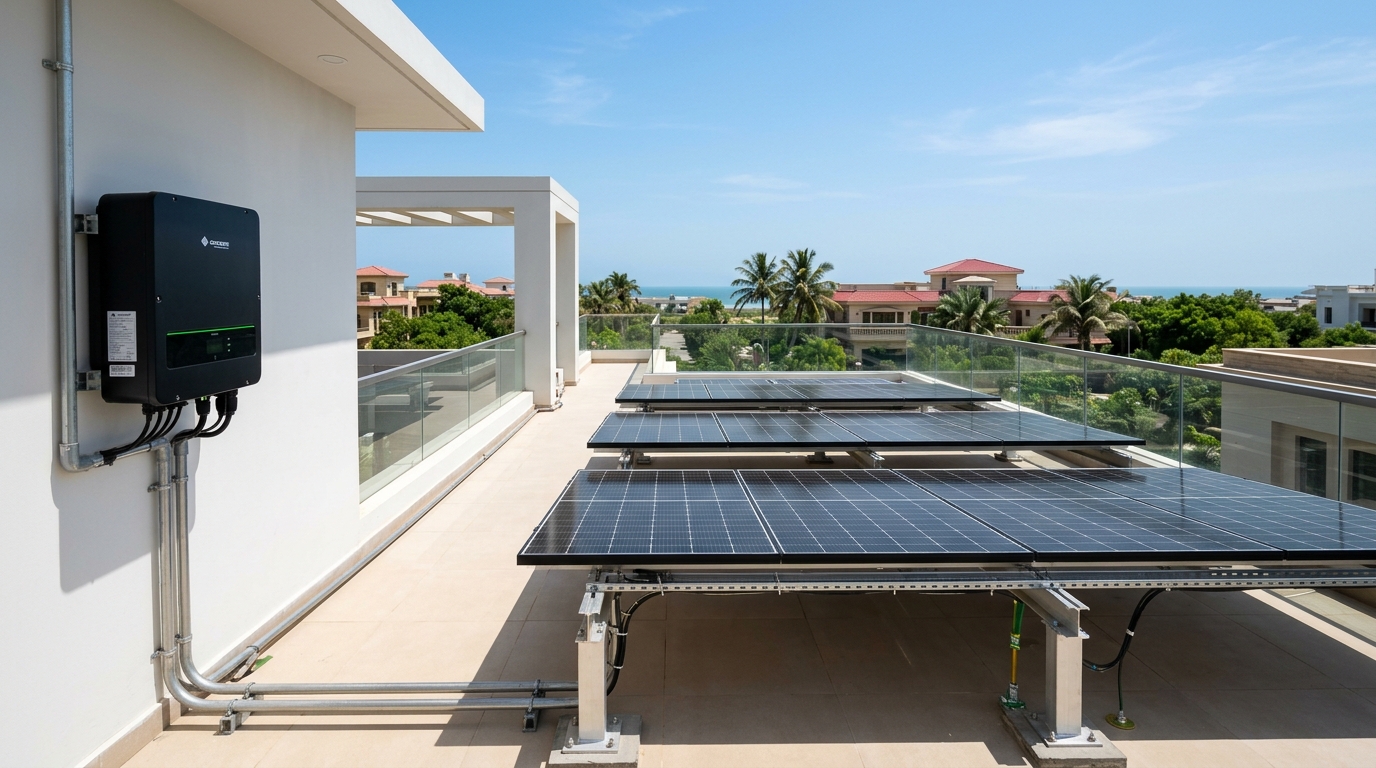
1. Comprehensive Solar Energy Overview: How Karachi's Dust and Pollution Affect Solar Panel Efficiency
Surging electricity tariffs across Pakistan, coupled with fuel cost adjustments (FCA), fixed capacity charges, and persistent grid load shedding, have made solar energy not merely an environmentally conscious choice, but an urgent financial imperative. This authoritative technical guide to How Karachi's Dust and Pollution Affect Solar Panel Efficiency delivers actionable engineering methodologies, mathematical load calculations, component comparisons, regulatory net-metering blueprints, and real-world financial models specifically tailored for property owners and facilities in Karachi and Pakistan.

Whether you are designing a high-efficiency rooftop array for a residential bungalow in DHA, Clifton, Bahria Town, or Gulshan-e-Iqbal, or planning a multi-hundred kilowatt industrial solar installation across SITE, Korangi, or Port Qasim, understanding the exact technical parameters of how karachi's dust and pollution affect solar panel efficiency prevents undersizing pitfalls, inverter faults, and regulatory licensing delays. FWB Ventures, recognized as a premier clean energy engineering contractor and authorized distributor in Pakistan, publishes this comprehensive resource to equip consumers and commercial engineers with verifiable, transparent industry insights.
Core Highlights of How Karachi's Dust and Pollution Affect Solar Panel Efficiency
- Primary Topic Focus: How Karachi's Dust and Pollution Affect Solar Panel Efficiency evaluated within Pakistan's complex electrical tariff structure and microclimate.
- Target Decision-Makers: Homeowners, businesses, factory managers, and EPC contractors focusing on How Karachi's Dust and Pollution Affect Solar Panel Efficiency.
- Core Technical Focus: Engineering and installation guide for How Karachi's Dust and Pollution Affect Solar Panel Efficiency in Karachi and Sindh.
- Photovoltaic Technology Standard: Tier-1 N-Type TOPCon & Bifacial Monocrystalline Modules (585W - 710W).
- Power Conversion Hardware: Tier-1 Smart Hybrid & String Inverters (Deye, Sungrow, Huawei, GoodWe, Solis).
- Grid Synchronization Protocol: K-Electric / NEPRA Bi-Directional Green Meter Net Billing (3-Phase).
- Karachi Insolation Yield: 4.2 to 4.8 peak sun hours daily (~1,550 to 1,680 kWh per kWp annually).
- Prevailing Market Investment Range: PKR 135 to PKR 175 per Watt turnkey installed depending on system topology and battery backup.
- Authorized Engineering Support: Turnkey consultation, structural design, and EPC commissioning via FWB Ventures (+92 301 2118111).
2. System Topology Breakdown: On-Grid vs. Hybrid vs. Off-Grid
Selecting the appropriate electrical architecture for How Karachi's Dust and Pollution Affect Solar Panel Efficiency dictates your capital investment, daily energy independence, and backup capability during utility grid blackouts:
| System Topology | K-Electric Net Metering | Load Shedding Blackout Protection | Battery Requirement | Ideal Application Profile |
|---|---|---|---|---|
| On-Grid (Grid-Tied) System | Yes (Direct 100% Export) | No (Shuts down during outage for anti-islanding safety) | None (Zero battery expenditure) | Urban properties with zero or minimal load shedding; maximum financial ROI and shortest payback period. |
| Hybrid Solar System (BESS) | Yes (Export surplus + charge battery) | Yes (Instant sub-10ms automatic UPS transfer) | LiFePO4 Lithium Battery Bank (48V / High-Voltage) | The premier choice for Karachi homes, clinics, and offices requiring 24/7 continuous uninterrupted power. |
| Off-Grid Standalone System | No (Completely detached from utility grid) | Yes (100% autonomous operation) | Large deep-cycle battery bank mandatory | Remote agricultural farmhouses, coastal islands, telecom towers, and areas with zero grid infrastructure. |
In urban Karachi, the vast majority of consumers benefit most from a Hybrid Solar System. In this configuration, solar power first satisfies your property's real-time daytime load. Any surplus energy is simultaneously diverted to charge a high-efficiency LiFePO4 battery bank. Once the batteries are fully topped off, secondary excess generation is exported into the K-Electric grid through the bidirectional net meter, earning valuable billing credits on your monthly utility statement.
---3. Mathematical Sizing & Energy Generation Calculation Framework
Precision sizing for How Karachi's Dust and Pollution Affect Solar Panel Efficiency ensures you do not waste capital on excess capacity or suffer from insufficient power generation. The mathematical framework below guides certified solar engineers when auditing a property:
// Formula 1: Daily Energy Consumption (Units / kWh)
Daily Units (kWh) = [ Monthly K-Electric Bill Units ] / 30 Days
// Formula 2: Required Solar Array Capacity (kWp)
System Size (kWp) = [ Daily Energy Demand (kWh) ] / [ Peak Sun Hours (h) × System Performance Ratio (PR) ]
Where Peak Sun Hours in Karachi = 4.5 h/day average, PR (Performance Ratio) = 0.78 to 0.82 accounting for inverter losses, cabling drop, soiling, and ambient heat.
// Formula 3: Number of Photovoltaic Modules Required
Module Quantity = [ System Capacity (kWp) × 1,000 W ] / [ Module Nameplate Rating (W) ]
Standard Sizing Matrix for Karachi Residential Properties
| Property Classification | Recommended System Size | Average Monthly Generation | Number of 585W Panels | Estimated Roof Space Needed |
|---|---|---|---|---|
| 120 Sq Yds (Small Residence) | 5 kW On-Grid / Hybrid | 600 - 700 Units / Month | 9 Panels (5.26 kWp) | 300 - 350 Sq. Ft. |
| 240 Sq Yds (Medium Residence) | 10 kW Hybrid System | 1,250 - 1,450 Units / Month | 18 Panels (10.53 kWp) | 600 - 700 Sq. Ft. |
| 500 Sq Yds (Large Villa / Bungalow) | 15 kW Hybrid System | 1,900 - 2,150 Units / Month | 26 Panels (15.21 kWp) | 900 - 1,050 Sq. Ft. |
| 1,000 Sq Yds (Luxury Estate) | 20 kW to 25 kW Hybrid | 2,600 - 3,300 Units / Month | 35 - 43 Panels | 1,300 - 1,600 Sq. Ft. |
| Commercial Office / Factory Floor | 50 kW to 100 kW+ Commercial | 6,500 - 14,000 Units / Month | 86 - 172 Panels | 3,200 - 6,500 Sq. Ft. |
4. Module Technology: Tier-1 N-Type TOPCon & Bifacial vs. Legacy P-Type PERC
Solar cell manufacturing has made a monumental leap over the past two years. Understanding panel technology is paramount when evaluating How Karachi's Dust and Pollution Affect Solar Panel Efficiency:
1. P-Type PERC vs. N-Type TOPCon
Older P-type Passivated Emitter and Rear Cell (PERC) technology suffers from Light-Induced Degradation (LID) and has a lower conversion efficiency ceiling (~21.0%). Modern Tier-1 installations utilize N-Type Tunnel Oxide Passivated Contact (TOPCon) cells, offering conversion efficiencies exceeding 22.8% to 23.5%. N-Type cells have zero Light-Induced Degradation, ensuring virtually zero power loss during the initial months of sunlight exposure.
2. Temperature Coefficient in Karachi's Extreme Heat
Karachi experiences rooftop surface temperatures exceeding 55°C during summer heatwaves. For every degree Celsius above standard test conditions (25°C), solar panels lose power based on their Temperature Coefficient of Maximum Power (Pmax):
- Legacy P-Type PERC: -0.38% / °C (A 30°C rise causes an 11.4% immediate power loss).
- Advanced N-Type TOPCon: -0.30% / °C (A 30°C rise causes only a 9.0% power loss, delivering up to 3% to 4% more real-world energy in hot climates).
3. Bifacial Double-Glass Advantage
Bifacial modules incorporate transparent glass on both the front and rear surfaces. Sunlight reflected from white roof coatings, light-colored ceramic tiles, or concrete screed (albedo radiation) is absorbed by the rear side of the solar cells. In elevated rooftop pergolas, bifacial gain adds an extra 10% to 18% in kilowatt-hour output without expanding the physical roof footprint!
---5. Tier-1 Solar Inverters: Topology, Efficiency & Smart Telemetry
The solar inverter is the computational core of the photovoltaic plant, converting direct current (DC) generated by panels into clean, grid-synchronized alternating current (AC):
| Inverter Brand & Category | MPPT Channels & Tracking | Peak Euro Efficiency | Lithium BMS Integration | Warranty & Remote Monitoring |
|---|---|---|---|---|
| Deye Hybrid Inverter (Low / High Voltage) | Dual MPPT (Independent tracking) | 97.6% - 98.4% | Native CANbus / RS485 closed-loop communication | 5-Year Standard Warranty; Smart Wi-Fi Solarman cloud telemetry. |
| Huawei SUN2000 Smart String Inverter | Multi-MPPT with AI Arc Fault Protection | 98.6% - 98.8% | High-voltage battery interface (LUNA2000) | 10-Year Manufacturer Warranty; FusionSolar mobile app. |
| Sungrow Commercial String / Hybrid | Up to 12 MPPTs for large industrial arrays | 98.5% | High-voltage commercial storage cabinets | 5 to 10-Year Warranty; iSolarCloud portal. |
| GoodWe Smart Energy Series | Dual MPPT with 150% DC oversizing | 98.2% | Full CANbus protocol compatibility | 5-Year Warranty; SEMS monitoring platform. |
6. K-Electric Net Metering Regulatory Roadmap & Step-by-Step Approval
To lawfully export surplus electricity to the grid and receive monthly utility credits under NEPRA Alternative Energy Distributed Generation Regulations, a formal 7-step engineering and bureaucratic process must be executed:
- 1. Site Feasibility & Sanctioned Load Audit: FWB Ventures inspects the property's incoming supply cable, transformer capacity, and billing history. The net-metered solar capacity cannot exceed 1.5× your sanctioned connected load in K-Electric billing records. (If required, we handle the sanctioned load extension application).
- 2. Engineering Single-Line Diagram (SLD) Design: Certified professional engineers draft detailed electrical schematics, specifying DC string breakers, AC distribution boards, surge protection devices (SPDs), and dual grounding pits.
- 3. K-Electric NOC & Feasibility Approval: Application documentation, equipment test certifications (IEC 62109, IEC 61727), and engineer certificates are submitted to the K-Electric regional integrated business center (IBC).
- 4. Physical System Installation & Testing: The solar system is completely mounted, wired, and pre-commissioned according to strict electrical engineering codes.
- 5. NEPRA Distributed Generation License: K-Electric forwards the verified engineering dossier to the National Electric Power Regulatory Authority (NEPRA) for issuance of the official generation license.
- 6. Disconnect Switch & Meter Testing: K-Electric metering inspectors audit the physical site, test anti-islanding isolation safety, and seal the external manual disconnect switch.
- 7. Bi-Directional Smart Green Meter Installation: The legacy unidirectional electric meter is removed and replaced with a digital bi-directional smart meter that records both imported units (from K-Electric) and exported units (from your solar system).
7. Prevailing Turnkey Installation Pricing & Financial ROI Matrix in Pakistan
Investing in solar energy is one of the highest-yield financial assets available in Pakistan today, generating internal rates of return (IRR) exceeding 32% to 40% per year:
| System Capacity | System Architecture | Estimated Turnkey Investment (PKR) | Monthly Bill Reduction (PKR) | Estimated Payback Period |
|---|---|---|---|---|
| 5 kW On-Grid | String Inverter + Net Metering | PKR 720,000 - 850,000 | PKR 35,000 - 45,000 | 2.0 - 2.4 Years |
| 10 kW Hybrid (5.12kWh LiFePO4) | Deye Hybrid + Net Metering + Battery | PKR 1,650,000 - 1,950,000 | PKR 75,000 - 95,000 | 2.4 - 2.8 Years |
| 15 kW Hybrid (10.24kWh LiFePO4) | Deye Hybrid + Net Metering + Battery | PKR 2,450,000 - 2,850,000 | PKR 115,000 - 145,000 | 2.3 - 2.7 Years |
| 20 kW Commercial / Large Villa | Dual Hybrid / String + Net Metering | PKR 2,950,000 - 3,450,000 | PKR 160,000 - 210,000 | 2.1 - 2.5 Years |
| 100 kW Industrial Rooftop | High-Voltage String Inverters | PKR 11,500,000 - 13,500,000 | PKR 700,000 - 950,000 | 1.8 - 2.2 Years |
8. Electrical Safety, Earthing Standards & Lightning Surge Protection
Photovoltaic installations operate under dangerous direct current (DC) potentials up to 1,000V DC. Unlike alternating current (AC), DC arcs do not self-extinguish at zero-voltage crossings, creating severe electrical fire hazards if inferior switchgear is installed:
- Dedicated DC Surge Protective Devices (SPD Type II): We install class-leading DC surge arresters on every MPPT string input to suppress destructive lightning transients and atmospheric over-voltages before they reach the sensitive inverter semiconductors.
- Dual Chemical Earthing Pits: FWB Ventures installs two completely segregated earth pits filled with low-resistivity bentonite and carbon earthing compound:
- AC Equipment Earth: Grounding the inverter chassis, AC distribution boards, and generator changeovers (Resistance < 5 Ohms).
- DC Structure & Lightning Earth: Interconnecting all solar panel aluminium frames, steel mounting structures, and early streamer emission (ESE) lightning rods (Resistance < 3 Ohms).
- Solar DC Cable Integrity: We utilize exclusively TÜV-certified 4mm² or 6mm² cross-linked polyethylene (XLPE) double-insulated tinned copper solar cables rated for 1,500V DC and UV exposure up to 120°C, encased in UV-stabilized conduits.
9. Karachi Microclimate Challenges: Marine Salt Mist, Smog & Cleaning Protocols
Karachi presents a unique and harsh operational environment for solar equipment. Overcoming these regional hurdles is vital to maintaining peak energy yield:
- Coastal Salt Mist & Marine Corrosion: Properties in DHA (Phases 5 to 8), Clifton, Port Qasim, and Korangi Creek experience airborne marine chlorides. All electrical enclosures must be minimum IP65 or IP66 weatherproof rated with stainless steel (SS316) screws and nickel-plated cable glands.
- Airborne Dust & Industrial Smog: Dust accumulation (soiling) reduces photon transmittance through solar glass by 15% to 25% within just two weeks. FWB Ventures equips installations with dedicated rooftop pressurized wash points and recommends a fortnightly washing schedule using soft demineralized water during early morning or sunset hours to prevent thermal shock glass cracking.
10. Frequently Asked Questions (FAQs) Regarding How Karachi's Dust and Pollution Affect Solar Panel Efficiency
Q1: Can a solar system run my 1.5-ton inverter air conditioners during the day?
Yes, easily. A 1.5-ton inverter AC consumes approximately 800 to 1,200 Watts once its variable-speed compressor stabilizes. A standard 10kW solar system generates approximately 7,500 to 8,500 Watts of direct solar electricity during peak sunshine hours, comfortably powering two to three 1.5-ton inverter ACs simultaneously along with refrigeration and lighting.
Q2: How long does the complete K-Electric net metering approval process take?
In Karachi, the complete turnkey net metering process—from initial site load audit and electrical drafting to K-Electric IBC feasibility, NEPRA licensing, and green meter installation—typically takes between 4 to 8 weeks when handled end-to-end by certified EPC contractor FWB Ventures.
Q3: What happens to my solar power generation during utility load shedding?
If you have an On-Grid system, the inverter immediately shuts down during a grid outage to protect line workers (anti-islanding safety). If you have a Hybrid system with a LiFePO4 battery bank, the inverter switches within 10 milliseconds to backup mode, keeping all essential home or office appliances operating without interruption.
Q4: Why are N-Type TOPCon panels superior to older P-Type PERC panels?
N-Type TOPCon panels feature zero Light-Induced Degradation (LID), higher efficiency (up to 23.5%), and a superior temperature coefficient (-0.30%/°C vs -0.38%/°C), enabling them to produce up to 3% to 4% more electricity under Karachi's severe summer heatwaves.
Q5: How many years of warranty coverage come with a Tier-1 solar system?
Tier-1 solar panels provide a 12-year product materials warranty and a 25-to-30-year linear performance warranty (guaranteeing at least 85% output at year 25). Tier-1 hybrid inverters (Deye, Sungrow, Huawei) include 5 to 10-year factory warranties, while Grade-A LiFePO4 batteries carry 5 to 10-year replacement warranties.
11. Consult FWB Ventures for Certified Turnkey Solar Solutions
Eliminate crippling electricity bills and secure 24/7 power autonomy for your home or commercial facility. Contact the certified clean energy engineering specialists at FWB Ventures today for technical audits, 3D rooftop modeling, and transparent turnkey quotes:
Explore Verified Karachi Engineering Services & Technical Guides
Connect with FWB Ventures' certified engineering divisions for turnkey site inspections, hardware specifications, and project quotations across Karachi.
Certified EPC on-grid, hybrid, and commercial solar systems with K-Electric net-metering approval.